
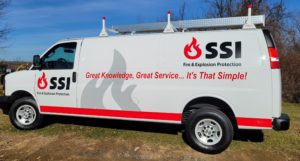
SSI hired our first installer in 1984, that employee is still with our company today. We have a wealth of knowledge and experience in our installation department. Some of
these technicians have been installing fire protection systems for over 100 years!! Our installers pride themselves on providing our customers with nothing short of excellence. They have built some strong relationship with some key customers that has resulted in recurring business for SSI. It is not uncommon for installers to work in some extreme conditions, rain, sleet, snow & freezers at temperatures’ below -10F.
As SSI is located in an area where often the project requires union labor. We have relationships with several local union electrical and mechanical companies that can provide the manpower required.
Room Construction for Clean Agent Systems
The construction of the room and proper sealing is important for the clean agent fire suppression system to work properly. We have two pages on our site that provide information to assist our customers to assure proper room integrity is obtained.
Design Considerations for Special Hazard Areas
Proper Room Sealing of Clean Agent Systems
Turnkey Fire Protection and Industrial Explosion System Installation Services
Turnkey fire protection and explosion system installation is the specialized process of integrating life safety hardware, clean agent suppression piping, addressable alarm loops, and high-speed explosion isolation devices into a facility according to strict engineering designs. Proper system installation ensures seamless communication between detection sensors, control panels, and releasing mechanisms, eliminating blind spots and preventing costly accidental system discharges. Executing installations through certified engineers guarantees full compliance with national life safety standards, insurance mandates, and local building codes.
For over 40 years, Suppression Systems Inc. (SSI) has delivered turnkey installation services for special hazard fire suppression, industrial explosion protection, and intelligent fire alarm networks. Our staff of NICET-certified engineers and factory-trained technicians manages every project lifecycle step, from initial hazard analysis and computer fluid modeling through field mounting, wiring, and final commissioning tests. We deliver code-compliant life safety installations across Pennsylvania, New Jersey, Maryland, Virginia, and Delaware.
Why Do Uncertified Fire System Installations Fail?
Special hazard suppression systems and high-speed explosion barriers operate under extreme pressure and tight timing tolerances. Mistakes made during field mounting or electrical wiring introduce severe liabilities that can leave your critical infrastructure unprotected during an actual thermal or deflagration event.
Improper Pipe Sizing and Pressure Loss Errors
Clean agent gaseous fire suppression systems require precise 10-second discharge timelines to extinguish fires effectively without damaging sensitive electronics. Incorrect pipe routing, poor elbow placement, or uncalculated pressure drops prevent the gaseous agent from achieving mandatory room concentration levels, causing system extinguishment failure.
Circuit Wiring and Ground Fault Vulnerabilities
Modern addressable fire alarm panels utilize digital Signaling Line Circuits (SLC) that require proper shielding and Class A or Class X return loop terminations. Substandard wiring practices cause intermittent ground faults, line noise, and communication dropouts that render field detectors unable to signal a fire condition.
Failed AHJ Acceptance Testing and Project Delays
Building inspectors and local fire marshals require rigorous functional acceptance testing before issuing a Certificate of Occupancy. Missing room integrity door fan tests, uncalibrated optical sensors, or incorrect actuator wiring lead to immediate inspection rejections, delaying facility opening schedules and inflating costs.
How Does SSI Manage the System Installation Process?
SSI applies a structured engineering framework to every installation project. By coordinating mechanical piping, electrical wiring, and digital panel logic, our teams ensure that every life safety asset performs reliably under emergency conditions.
| Installation Milestone | SSI Field Execution Standard | Quality Verification & Code Outcome |
|---|---|---|
| Pre-Installation Planning | NICET engineering drawing review, computer flow calculation verification, and BIM coordination. | Prevents field trade conflicts and ensures correct agent quantity calculations. |
| Mechanical & Piping Tie-Ins | Heavy-wall pipe installation, rigid structural bracings, and precise discharge nozzle orientation. | Satisfies high-pressure discharge requirements under NFPA 2001 and NFPA 12. |
| Electrical & Control Cabling | Supervised signaling circuits, fire-rated conduit runs, and addressable loop terminations. | Guarantees continuous circuit monitoring and zero ground fault interference. |
| Commissioning & Testing | Pneumatic pressure testing, room integrity door fan testing, and AHJ walk-through validation. | Secures formal AHJ sign-off and immediate facility Certificate of Occupancy. |
Room Integrity Door Fan Sealing Tests
Clean agent suppression systems require an airtight room envelope to maintain fire-extinguishing gas concentrations for a minimum 10-minute hold time. During installation, SSI performs computerized door fan testing to locate room leakage paths, ensuring penetrations are properly sealed before agent cylinders are connected.
High-Speed Explosion Isolation Mounting
Installing industrial explosion protection requires mounting millisecond-response chemical isolation cannons and fast-acting gate valves on process ductwork. SSI technicians position optical and pressure sensors to trigger active suppressants before a deflagration wave can travel to connected machinery.
Comprehensive System Installation Services from SSI
SSI provides turnkey installation for a broad range of special hazard fire suppression, explosion protection, and commercial life safety systems. Our technicians work seamlessly alongside general contractors, facility managers, and electrical engineers to deliver clean, on-time project execution.
Special Hazard Fire Suppression System Installation
We install clean agent fire suppression systems including ECARO-25, ProInert2, and FK-5-1-12, as well as high-pressure CO2, specialty water mist, and dry chemical systems. Our installations protect mission-critical equipment without introducing conductive water residue.
Explore Fire Suppression Options | View Clean Agent PlatformsIndustrial Explosion Protection System Installation
Operating as a subsidiary of Fike Corporation, SSI installs engineered explosion suppression, active chemical isolation, flameless venting, and spark detection systems. We protect dust collectors, mills, silos, and bucket elevators handling combustible organic dusts.
Learn About Dust Explosibility TestingCommercial Fire Alarm and Advanced Detection Installation
We install intelligent addressable fire alarm panels from premier manufacturers including Autocall and Fike. Our detection capabilities feature VESDA aspirating smoke detection networks, industrial thermal imaging, and public safety BDA/ERCES amplifiers.
Explore Fire Alarm Networks | View VESDA Air Sampling SystemsEngineering Excellence: SSI maintains an in-house clean agent cylinder recharge facility, allowing us to perform rapid, local cylinder fills and hydrostatic testing during system commissioning or post-discharge maintenance.
What Codes Govern Fire and Explosion System Installation?
Life safety and explosion protection installations must strictly comply with national standards to verify system reliability. Facility owners must ensure installation teams follow applicable regulatory frameworks to secure insurance approval and municipal permitting.
| Code Standard | System Installation Mandates & Scope |
|---|---|
| NFPA 72 & NFPA 70 | Governs national fire alarm installation, signaling circuit wiring, loop supervision, device spacing, and national electrical code compliance. |
| NFPA 2001 & NFPA 12 | Dictates clean agent and carbon dioxide system piping installation, cylinder mounting, pressure testing, and discharge nozzle positioning. |
| NFPA 68 & NFPA 69 | Regulates explosion venting and prevention systems, requiring certified mounting of explosion isolation barriers and chemical suppressors. |
| OSHA 29 CFR 1910 | Enforces general industry safety regulations, workplace hazard controls, and proper electrical installation in hazardous classified locations. |
Because building classifications and municipal amendments vary, your local Authority Having Jurisdiction (AHJ) retains ultimate final approval over all installation plans. Access official safety standards directly through the National Fire Protection Association (NFPA) documentation portal.
Where Is Professional System Installation Essential?
Complex industrial facilities require precise, certified installation to ensure life safety hardware performs flawlessly without interfering with daily operations.
Data Centers, Telecom Vaults, and Cleanrooms
These high-density electronics spaces require specialized clean agent piping and VESDA aspirating air sampling networks. Installing non-conductive gaseous suppression ensures fires are extinguished within seconds without damaging server hardware or leaving chemical residue.
Combustible Dust Processing and Manufacturing Plants
Wood processing facilities, chemical plants, and mills generate fine organic particulates. Installing fast-acting explosion isolation valves and chemical suppression cannons on dust collection lines prevents small deflagrations from escalating into catastrophic plant explosions.
High-Bay Logistics Warehouses and BESS Storage Sites
Vast vertical clearances cause smoke stratification that bypasses standard spot detectors. SSI installs video imaging smoke detection (VFD) and off-gas monitoring (Li-ion Tamer) to catch early thermal runaway in battery storage bays and high-rack storage facilities.
Frequently Asked Questions
What does a turnkey fire protection system installation include?
A turnkey installation managed by SSI includes initial site hazard evaluation, NICET computer design drawings, equipment procurement, physical pipe and conduit mounting, electrical wiring, panel programming, room integrity testing, AHJ acceptance testing, and operator training.
Why is professional installation required for clean agent fire suppression?
Clean agent systems discharge gaseous suppressants within 10 seconds under high pressure. Precise pipe sizing, nozzle placement, and room integrity fan testing are required to ensure the system achieves and maintains the correct fire-extinguishing gas concentration without over-pressurizing the enclosure.
What national codes govern fire alarm and suppression system installations?
System installations are governed primarily by NFPA 72 for fire alarms, NFPA 2001 for clean agents, NFPA 12 for carbon dioxide, NFPA 68 and 69 for explosion protection, and OSHA 29 CFR 1910 for workplace safety standards.
How long does a typical special hazard system installation take?
Installation timelines depend on room dimensions, piping complexity, and equipment lead times. Standard clean agent installations in server rooms typically take 1 to 3 weeks, while large multi-zone industrial explosion protection projects are scheduled in phases to align with construction milestones.
Can SSI install systems in active facilities without shutting down operations?
Yes. SSI routinely executes installations in operating data centers, hospitals, and manufacturing plants. Our installation teams schedule work during off-peak hours and follow strict containment procedures to prevent operational disruptions or dust contamination.
What is required for a facility to pass final AHJ acceptance testing?
Passing AHJ acceptance testing requires verified as-built drawings, functional cause-and-effect matrix testing, battery load verification, room integrity hold-time reports, and visual inspection of all piping, conduits, and emergency releasing controls.
Does SSI provide installation services for industrial explosion protection hardware?
Yes. As a Fike Corporation subsidiary, SSI installs engineered explosion suppression cannons, fast-acting isolation valves, flameless explosion vents, and spark detection systems on dust collectors, silos, and process machinery across the region.
What geographic service area does SSI cover for system installation?
SSI provides complete installation, commissioning, and ongoing maintenance services across Pennsylvania, New Jersey, Maryland, Virginia, Delaware, and the surrounding Mid-Atlantic service footprint.
The SSI Approach to System Installation
Our engineered installation methodology guarantees system performance through rigorous planning, certified field execution, and complete testing validation.
1. Design: Our NICET-certified engineers conduct a site survey, model room agent flows, and generate stamped installation drawings.
2. Install: Factory-trained installers mount piping bracings, pull supervised signaling wires, and position specialized detection hardware.
3. Commission: We complete pneumatic line testing, perform room integrity door fan tests, and host final acceptance testing with the local AHJ.
4. Train: SSI provides comprehensive operator training, teaching your facility personnel panel interface commands, trouble clearing, and reset steps.
5. Service: Backed by over 40 years of local history, our field service team provides scheduled preventative testing, cylinder recharging, and 24/7/365 emergency support.
Schedule Your System Installation with SSI
Do not leave your facility’s safety or project schedule to chance with uncertified installers. Partnering with SSI ensures your fire suppression, explosion protection, or alarm system is installed to the highest engineering standards and passes inspection on time.
Contact our team today to discuss your upcoming project or request an installation estimate with an SSI System Design Consultant.
Schedule Your Installation: Contact SSI Online or call 1-800-360-0687. Corporate Office: Breinigsville, PA. Serving PA, NJ, MD, VA, and DE.
You must be logged in to post a comment.