
Industrial Fire and Explosion Protection Systems
Suppression Systems, Inc. (SSI) provides turnkey engineering, hardware installation, and 24/7 emergency dispatch for facilities where ordinary commercial water sprinklers are not an option. From combustible dust explosion mitigation to high-speed clean agent suppression, we protect your mission-critical operations.
1983
Year Established
160+
Years Tech Experience
< 24h
Cylinder Recharge Turnaround
24/7/365
Emergency On-Call Dispatch
Engineered Life Safety & Hazard Mitigation Solutions
Explore our specialized engineering pillars, code-compliant equipment platforms, and lifecycle service programs.
Industrial Explosion Protection
Certified deflagration protection complying with the unified NFPA 660 code. We protect mills, dust collectors, silos, and pneumatic conveyance lines.
- Combustible Dust Testing: Go/No-Go, Kst, Pmax & MIE analysis.
- Dust Hazard Analysis (DHA): On-site process engineering evaluations.
- Passive & Active Isolation: Flameless venting & high-speed valves.
- Flamex Spark Detection: Infrared spark extinguishment systems.
Gaseous Fire Suppression
Electrically non-conductive gaseous and aerosol systems extinguishing Class A, B, and C fires at the molecular level without leaving moisture or residue.
- Platinum Partner of Firetrace: Pre-engineered CNC & cabinet tubing.
- FirePro Condensed Aerosol: Solid FPC generators for battery vaults.
- Monarch Pyro-Chem: Dry-chemical systems for paint spray booths.
- Fike Clean Agents: ECARO-25®, FK-5-1-12 & FM-200® server room flooding.
Water Suppression Systems
Specialized water mist and supersonic nitrogen hybrid platforms engineered for high-heat machinery spaces where standard sprinklers cause severe thermal shock.
- Victaulic Vortex™ Hybrid: Supersonic atomization using 97% less water.
- Fike MicroMist®: Self-contained intermediate pressure mist packages.
- Machinery & Turbine Defense: Rapid cooling without casing distortion.
- No Room Sealing Dependency: Operates in naturally ventilated spaces.
Fire Panels & Alarms
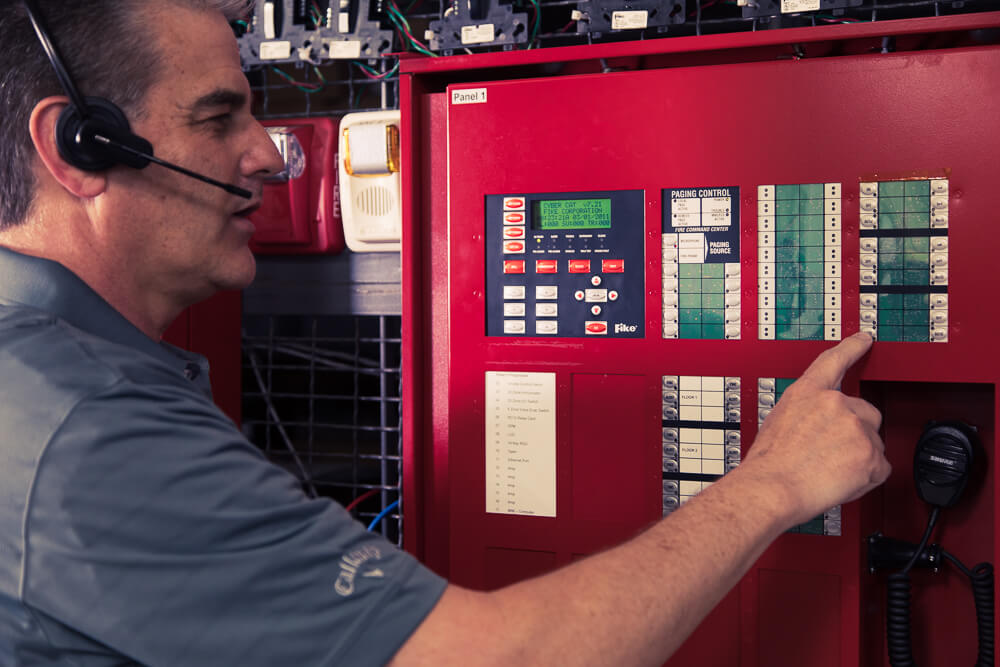
Enterprise addressable life-safety networks, emergency voice evacuation, mass notification, and code-mandated emergency responder radio enhancement.
- Autocall 4100ES Flagship: Campus network panels up to 3,000 points.
- Autocall 4010ES & 4007ES: Mid-capacity and compact color touchscreens.
- Autocall Foundation Series: Budget-aligned standalone commercial units.
- ERCES / BDA Systems: NFPA 1221 in-building public safety radio coverage.
Specialty Fire Detection
Ultra-sensitive air-sampling and optical radiation sensors designed to detect combustion hours before standard commercial spot smoke detectors activate.
- Xtralis VESDA®: Laser air sampling for data centers and cold storage.
- Thermal Imaging: Radiometric monitoring for lithium-ion battery BESS.
- Optical Flame Detectors: Multi-Spectrum IR3 sensors for instant flame release.
- Linear Heat Cables: Continuous thermal cable detection for conveyors.
Turnkey Services & Repair
Full-lifecycle engineering support from initial CAD hydraulic designs and dedicated project management to union installation and 24/7 cylinder emergency dispatch.
- System Design & Engineering: Hydraulic calculations & damper ties.
- Dedicated Project Managers: AHJ coordination & permit sign-offs.
- Experienced Installation: Union & non-union extreme-condition crews.
- 24/7/365 Emergency Dispatch: Rapid cylinder refills via 800-360-0687.
“Trust is Earned” — Why Industrial Operators Partner With SSI
At Suppression Systems, Inc., we have earned the trust of enterprise clients across the Mid-Atlantic since 1983. Our technicians bring over 160 years of combined service experience, supported by our Breinigsville warehouse stocking all major extinguishing agents—including Halon, FM-200, ECARO-25, and FK-5-1-12 (Novec 1230). When a system discharges, we return your facility to active compliance within 24 hours (and often within hours).
Request Information
“*” indicates required fields
"*" indicates required fields