
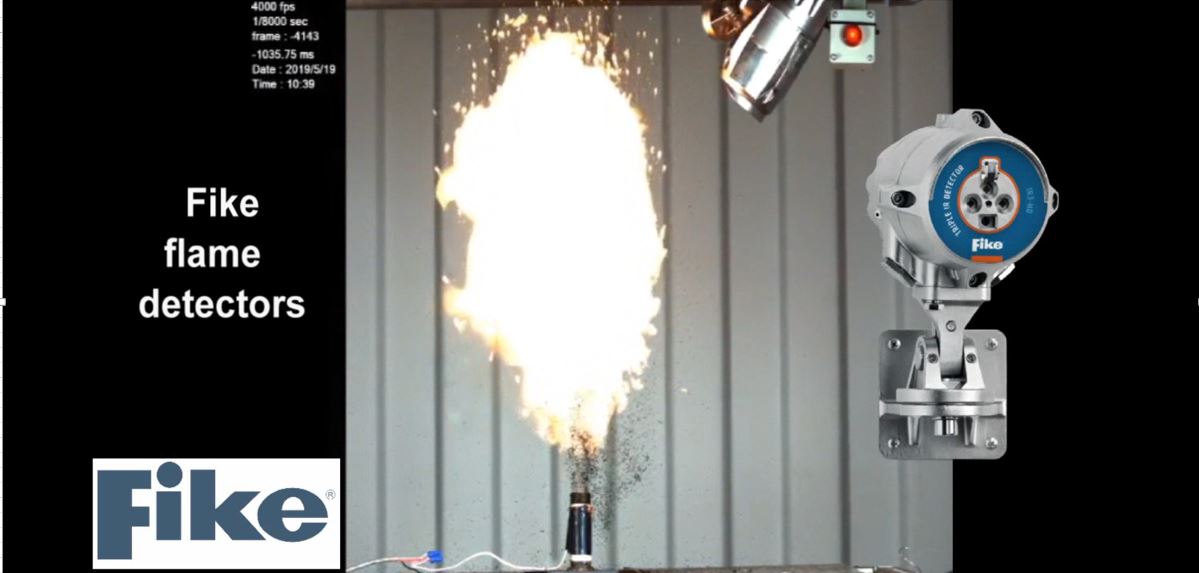
Optical Flame Detection Systems
Optical flame detectors are radiant energy-sensing devices that detect the ultraviolet (UV) and/or infrared (IR) radiation emitted directly by an open flame. Unlike smoke or heat detectors — which wait for combustion byproducts to reach a sensor — optical detectors respond to the fire itself, producing alarm times measured in seconds for close-range flammable liquid and gas fires. They are the required or preferred solution for aircraft hangars, fuel handling facilities, chemical plants, petroleum refineries, LNG terminals, and turbine enclosures: any industrial occupancy where a fast-developing fire cannot wait for smoke to accumulate before detection occurs.
How Does Optical Flame Detection Work?
Every flame emits electromagnetic radiation across a broad spectrum — from ultraviolet through visible light and into infrared. Optical flame detectors use photosensitive sensors tuned to specific bands of that spectrum to distinguish a real fire event from background radiation sources such as sunlight, artificial lighting, arc welding, or hot process equipment.
The core detection logic operates in three steps:
- Radiation sensing: One or more optical sensors continuously measure incoming electromagnetic radiation in the UV and/or IR bands within the detector’s field of view.
- Signature analysis: The detector’s onboard processing compares the incoming signal against the characteristic signature of an open flame — including the flicker frequency common to hydrocarbon combustion, typically in the 5–30 Hz range in the infrared band.
- Alarm output: When the signal matches the stored fire signature — and in multi-spectrum detectors, is confirmed simultaneously across multiple independent channels — the detector initiates an alarm signal to the fire alarm control panel or releasing panel.
This direct-to-flame detection method is what makes optical detectors essential in applications where a flammable liquid or gas fire cannot be permitted to develop before detection initiates a suppression response.
UV vs. UV/IR vs. Triple IR: Which Optical Flame Detector Is Right for Your Application?
Three primary optical flame detection technologies are available, each with distinct trade-offs in response speed, false alarm immunity, and environmental suitability. Selecting the wrong technology for an application is one of the most common design errors SSI’s engineers encounter during facility assessments.
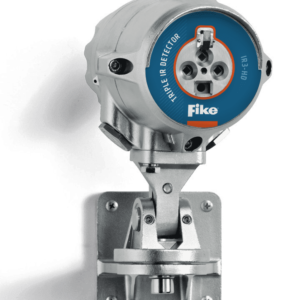
Fike Triple IR (IR3) flame detector — engineered for high-challenge industrial environments.
| Technology | How It Detects | Key Strengths | Key Limitations | Best Environment |
|---|---|---|---|---|
| UV Only | Single ultraviolet sensor | Very fast response; detects hydrogen fires (invisible to IR) | High susceptibility to false alarms from arc welding, lightning, X-rays, and sunlight | Controlled indoor spaces; hydrogen fuel applications |
| UV/IR | Combined UV and single IR sensor; requires simultaneous signal on both channels | Significantly fewer false alarms than UV-only; better suited than UV for semi-outdoor use | Can still be triggered by sources that simultaneously activate both bands | Semi-controlled industrial interiors; general hydrocarbon environments |
| Triple IR (IR3) | Three independent infrared channels; alarm only when all three confirm simultaneously | Highest false alarm immunity; solar blind; performs in direct sunlight and outdoor environments | Does not reliably detect hydrogen or pure alcohol fires (low IR emission) | Outdoor and harsh industrial environments; aircraft hangars; refineries; turbine enclosures; LNG facilities |
When Should You Use Optical Detection vs. Other Fire Detection Technologies?
Optical flame detection is a specialized technology — not a universal replacement for smoke or heat detection. It solves specific problems that conventional detectors cannot. The table below outlines where optical detection is the right choice and where complementary technologies are better suited.
| Technology | Primary Threat Detected | Ideal Environment | Key Limitation |
|---|---|---|---|
| Optical / Flame | Open flammable liquid or gas fires | High-ceiling, outdoor, or heavily ventilated industrial spaces | Does not detect smoldering fires; requires unobstructed line of sight |
| VESDA / Aspirating Smoke | Incipient, pre-flaming fire stages | Data centers, clean rooms, high-value protected spaces | Not designed for fast-developing flammable liquid or gas fires |
| Linear Thermal Detection | Heat rise along a cable or pipe run | Cable trays, tunnels, conveyor systems, cold storage perimeters | Fire must physically reach the detection cable to activate |
| Video Imaging Detection | Flame and smoke via visual analysis | Large open spaces, ports, perimeter monitoring | Performance depends on camera field of view and ambient lighting conditions |
| Thermal Imaging | Heat anomalies and thermal runaway | Battery energy storage systems, EV charging facilities, warehouses | Requires unobstructed thermal line of sight to the monitored surface |
What NFPA Codes Govern Optical Flame Detection?
Optical flame detectors must be selected, installed, and maintained in compliance with several NFPA standards, depending on occupancy type and the specific hazard present. The table below covers the primary standards SSI works to on optical detection projects across the Mid-Atlantic region.
| Standard | Full Title | Relevance to Optical Flame Detection |
|---|---|---|
| NFPA 72 | National Fire Alarm and Signaling Code | Chapter 17 governs radiant energy-sensing fire detectors — including UV, IR, and multi-spectrum (IR3) devices — covering listing requirements, spacing, field-of-view calculations, and placement criteria |
| NFPA 409 | Standard on Aircraft Hangars | Requires specific detection system types for Group I and Group II hangars; optical flame detection is a primary method for large-clearance hangar bays where ceiling heights prevent conventional detectors from meeting response time requirements |
| NFPA 30 | Flammable and Combustible Liquids Code | Applies to fuel storage, dispensing, and processing areas; optical detection is appropriate for open-floor fuel handling areas where flammable liquid pool fires are the primary scenario |
| NFPA 59A | Standard for the Production, Storage, and Handling of Liquefied Natural Gas (LNG) | LNG fire scenarios involve rapid-developing flammable gas fires with minimal smoke production; optical detection is the appropriate primary technology for storage areas, compressor buildings, and processing modules |
| NFPA 86 | Standard for Ovens and Furnaces | Industrial ovens and dryers using flammable solvents or gas; flame detection confirms loss of flame or detects uncontrolled ignition events in the burner zone |
Code compliance is the floor, not the ceiling. Authority Having Jurisdiction (AHJ) interpretation, insurer requirements, and site-specific hazard assessments also drive optical detection design decisions. SSI works directly with facility engineers, AHJs, and insurance underwriters to ensure every installation is compliant and fully defensible.
Where Is Optical Flame Detection Used?
Optical flame detectors are the primary detection method in any environment where flammable liquids or gases are present, ceilings are high enough to delay conventional detector activation, or ventilation would dilute combustion products before a smoke detector responds. Key applications SSI designs and installs across Pennsylvania, New Jersey, Maryland, Virginia, and Delaware:
Aircraft Hangars
Aircraft hangars present one of the most demanding flame detection challenges in any built environment. Ceiling heights in Group I and Group II hangars can reach 20 feet or more, rendering conventional spot detectors unable to meet the response time requirements of NFPA 409. Jet fuel fires — Jet-A, JP-8 — develop at an extremely rapid rate, and even a brief detection lag can allow a fire to spread across the apron before suppression agents discharge.
Triple IR (IR3) detectors are positioned to provide overlapping field-of-view coverage across the hangar floor, with detection logic tied directly to the suppression releasing panel. SSI has engineered NFPA 409-compliant optical detection systems for commercial, military, and private aviation facilities throughout the Mid-Atlantic region.
→ See SSI’s full technical guide: Aircraft Hangar Fire Detection Under NFPA 409
Petroleum Refineries and Fuel Terminals
Refineries and bulk liquid fuel terminals handle large volumes of flammable materials across open process areas, loading racks, and tank farms. Outdoor and semi-outdoor environments — combined with the fire characteristics of hydrocarbon fuels — make Triple IR detectors the standard specification at these facilities. Detection zones are engineered to ensure that any ground-level fuel spill fire is detected and reported before it can escalate to adjacent equipment or neighboring tanks.
Chemical Processing and Manufacturing
Chemical facilities handling flammable solvents, alcohols, or reactive gases require detection at the point of release — not after smoke has had time to accumulate. Optical detectors are commonly specified for reactor rooms, solvent storage areas, and chemical loading stations. In applications involving hydrogen or other fuels with low infrared emission, UV or UV/IR detectors are required. If a facility has both hydrocarbon and hydrogen scenarios, a combination of IR3 and UV/IR devices may be specified across different detection zones.
Turbine Enclosures and Power Generation
Gas turbine enclosures combine high air velocity, elevated ambient temperatures, and pressurized flammable fuel — an environment where smoke detectors cannot function reliably. Optical flame detectors are installed inside turbine enclosures to provide immediate fire detection independent of airflow direction or smoke transport. Turbine package OEMs and facility engineers specify flame detection as the primary initiating device for turbine fire suppression systems.
LNG and Natural Gas Processing Facilities
Liquefied natural gas fires burn with high intensity and very low smoke production. Optical detection — governed by NFPA 59A — is the appropriate primary technology for outdoor LNG storage areas, compressor buildings, and processing modules. Triple IR detectors are specified for these outdoor environments, where solar radiation and weather exposure rule out UV-based technologies.
Road Tunnels and Underground Infrastructure
Vehicle tunnels present a unique detection challenge: forced ventilation systems move smoke longitudinally along the tunnel bore, often away from incident-mounted spot detectors. Optical flame detectors respond to fire radiation directly — independent of the direction smoke travels — making them effective even when ventilation displaces combustion products away from a ceiling sensor array. In many tunnel designs, flame detection is combined with linear thermal detection for overlapping coverage.
The Fike Triple IR (IR3) Flame Detector
SSI is a certified Fike distributor and authorized installer. For the majority of industrial flame detection applications we engineer, we specify the Fike Triple IR (IR3) detector — a multi-spectrum infrared flame detector built for demanding environments where false alarm immunity and detection reliability must both be uncompromising.
The Fike IR3 uses three independent infrared sensors operating at different wavelengths. An alarm is generated only when all three channels simultaneously confirm the characteristic radiation pattern of a real hydrocarbon flame. This multi-channel confirmation architecture is what distinguishes the IR3 from single-channel IR and UV/IR technologies, and is why it is the industry-recognized standard for high-consequence releasing applications where a nuisance discharge is operationally or financially unacceptable.
Primary applications for the Fike IR3 include:
- Aircraft hangars (NFPA 409)
- Petroleum refineries and fuel terminals
- Turbine enclosures and power generation facilities
- Chemical and petrochemical processing areas
- LNG storage and natural gas processing facilities
- Marine and offshore platforms
As a Fike certified partner, SSI engineers specify, install, test, and service Fike flame detection equipment throughout our service area. Learn more about SSI’s full Fike product line at our Fike solutions page.
How Does Optical Detection Integrate with Fire Alarm and Suppression Panels?
Optical flame detectors are initiating devices — they generate an alarm signal that must be received, processed, and acted upon by a fire alarm control panel or a dedicated suppression releasing panel. In industrial releasing applications, the detection-to-suppression signal chain is where system design decisions have their greatest consequences.
SSI designs optical detection systems integrated with Fike suppression releasing panels and Autocall fire alarm control panels. Key integration design decisions include:
- Cross-zone logic: Many releasing applications require two optical detectors to alarm before suppression agent is discharged, preventing a single detector fault from triggering an accidental release.
- Pre-alarm outputs: A first-detector alarm can trigger ventilation shutdown, equipment de-energization, and audible/visual warning before the cross-zone confirmation initiates agent release — buying time for personnel egress.
- EPO integration: In facilities with emergency power-off requirements, optical alarm inputs can be wired to Emergency Power Shutdown Management Systems (EPSMS) to de-energize equipment at the moment of detection.
- Suppression agent compatibility: The detection-to-release sequence is engineered in coordination with the suppression system — whether CO₂, dry chemical, clean agent, or water mist — to ensure delay timing, abort sequences, and lockout provisions are correctly configured.
For a detailed overview of how detection and suppression systems work together from a systems engineering perspective, see: Fire Alarm & Suppression Integration — A Practical Guide.
- Advanced Fire Detection Systems Overview
- VESDA — Very Early Smoke Detection
- VESDA Guide: Very Early Smoke Detection Explained
- Video Imaging Fire Detection
- Linear Thermal Detection
- Thermal Imaging Monitoring
- Aircraft Hangar Fire Detection Under NFPA 409
- How to Choose the Right Fire Alarm Control Panel
- Design Considerations for Special Hazards
- Fike Fire Protection Solutions
- Autocall Fire Alarm Systems
Frequently Asked Questions: Optical Flame Detection
What is the difference between optical flame detection and smoke detection?
Smoke detectors respond to combustion particles in the air — they require fire byproducts to physically travel to the sensor before an alarm activates. Optical flame detectors respond to the electromagnetic radiation emitted directly by an open flame. This makes flame detectors fundamentally faster for flammable liquid and gas fire scenarios, and effective in high-ceiling or heavily ventilated environments where smoke may never reach a ceiling-mounted spot detector at the concentrations needed to trigger an alarm.
Can optical flame detectors work outdoors?
Yes — but detector technology selection is critical for outdoor installations. UV-only detectors are not suitable for outdoor use because solar radiation produces ultraviolet energy that can cause nuisance alarms. Triple IR (IR3) detectors are engineered specifically for outdoor environments, using multi-channel infrared confirmation logic to distinguish a real hydrocarbon fire from sunlight and other radiation sources. IR3 is the standard specification for outdoor refinery areas, fuel loading racks, aircraft aprons, and LNG storage areas.
Does NFPA 72 cover optical flame detectors?
Yes. NFPA 72 Chapter 17 covers radiant energy-sensing fire detectors, which includes UV, single-IR, UV/IR, and Triple IR (IR3) flame detectors. The code addresses listing requirements, spacing methodology, field-of-view calculations, placement criteria, and testing procedures. Additional occupancy-specific standards — including NFPA 409 for aircraft hangars and NFPA 30 for flammable liquid facilities — impose further requirements on top of NFPA 72.
What causes false alarms in optical flame detectors?
UV detectors are susceptible to nuisance alarms from arc welding operations, lightning, X-ray equipment, and direct or reflected sunlight. Single-channel IR detectors can be triggered by hot process surfaces, rotating machinery, and certain industrial light sources. Triple IR (IR3) detectors significantly reduce false alarm risk by requiring simultaneous confirmation across three independent infrared channels — making them the appropriate choice for releasing applications where an unwanted suppression discharge carries serious operational, safety, or financial consequences.
Can a Triple IR (IR3) detector detect hydrogen fires?
No. Hydrogen burns with a nearly invisible flame that emits very little infrared radiation, which means IR3 detectors are not suitable for pure hydrogen fire detection. UV or UV/IR detectors are the appropriate technology for hydrogen applications. If a facility has both hydrocarbon and hydrogen fire scenarios — as some chemical plants and power generation facilities do — a combination of UV/IR and IR3 detectors may be required across different detection zones. SSI engineers assess fuel types and fire scenarios as part of every optical detection design.
How does optical flame detection integrate with fire suppression systems?
Optical flame detectors function as initiating devices within a fire alarm or suppression releasing system. When a detector alarms, the signal is processed by a fire alarm control panel or releasing panel, which executes the programmed response sequence — typically including ventilation shutdown, equipment de-energization, audible/visual notification, and in releasing applications, suppression agent discharge after a time delay or upon cross-zone confirmation from a second detector. SSI designs detection-to-suppression sequences for CO₂, dry chemical, clean agent, and water mist systems.
Does SSI design and install optical flame detection systems?
Yes. SSI has designed and installed optical flame detection systems for industrial facilities across Pennsylvania, New Jersey, Maryland, Virginia, and Delaware for over 40 years. Our NICET-certified engineers specify detection technology based on facility-specific fire scenarios, occupancy type, applicable NFPA codes, and suppression system integration requirements. SSI is a certified Fike distributor and Autocall-authorized integrator.
Talk to an SSI Engineer About Optical Flame Detection
SSI has over 40 years of experience designing and installing optical and flame detection systems for industrial facilities throughout the Mid-Atlantic region. Our NICET-certified engineers evaluate your specific hazards, fire scenarios, applicable codes, and suppression integration requirements before recommending any detection technology.
Serving Pennsylvania, New Jersey, Maryland, Virginia, and Delaware.
155 Nestle Way, Suite 104 • Breinigsville, PA 18031