
Li-Ion Tamer Off-Gas Detection — The Earliest Warning of Lithium-Ion Battery Failure
Li-Ion Tamer is the industry’s leading off-gas detection system for lithium-ion battery installations, identifying electrolyte solvent vapors released by failing cells 2 to 30 minutes before thermal runaway begins. Manufactured by Honeywell, the current Li-Ion Tamer Gen 3 platform is FM 6540 Approved for Battery Electrolyte Solvent Vapours and ETL listed to UL 61010 — establishing it as the verified, certified solution for early-warning BESS fire safety under NFPA 855 requirements.
Suppression Systems, Inc. (SSI) designs, installs, and maintains Li-Ion Tamer Gen 3 systems across Pennsylvania, New Jersey, Maryland, Virginia, and Delaware. For over 40 years, our NICET-certified engineers have engineered fire detection and suppression for the East Coast’s most demanding facilities — and we deploy Li-Ion Tamer as part of a complete, integrated lithium-ion fire safety strategy aligned with the NFPA 855 (2026 edition) requirements for battery energy storage systems.

What Is Li-Ion Tamer?
Li-Ion Tamer is a purpose-built off-gas detection system for lithium-ion battery installations — engineered specifically to identify the volatile organic compounds (VOCs) released by failing cells during the earliest stages of thermal degradation. Unlike smoke, heat, or flame detection, Li-Ion Tamer responds to a chemical signature that appears before a fire is possible.
The technology was originally developed by Nexceris, acquired by Honeywell, and is now deployed globally across utility-scale BESS, data centers, EV charging infrastructure, telecom facilities, and manufacturing sites. The current platform — Li-Ion Tamer Gen 3 — represents the third major generation of the technology and is the version SSI installs in all new projects.
What Li-Ion Tamer Gen 3 does in one sentence: It continuously samples the air at strategic points throughout a battery installation, identifies the trace electrolyte solvent vapors (diethyl carbonate, dimethyl carbonate, ethyl methyl carbonate) that lithium-ion cells release when they begin to fail, and alerts the building’s fire alarm and emergency response systems — typically 2 to 30 minutes before thermal runaway begins.
Why Off-Gas Detection Is Critical for Lithium-Ion Safety
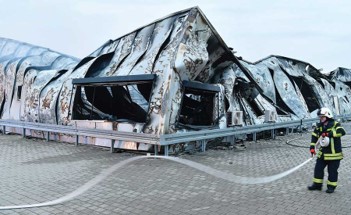
Thermal runaway is a self-sustaining exothermic reaction inside a lithium-ion cell. Once it begins, internal temperatures can climb from 80 °C to over 1000 °C within seconds, and the cell vents flammable gases that can ignite the adjacent cells in a propagating cascade. Once propagation begins, conventional suppression rarely contains the event — leading to the multi-day fires seen at high-profile BESS incidents in California and elsewhere.
The critical engineering question is when the failure becomes detectable. Lithium-ion thermal runaway unfolds in four phases, and each detection technology operates at a different phase:
| Phase | What Happens | Detection Technology |
|---|---|---|
| 1. Abnormal heating | Cell temperature rises above operating range due to internal fault | Thermal imaging |
| 2. Off-gas release | Cell vents electrolyte solvent vapors (DEC, DMC, EMC) | Li-Ion Tamer off-gas detection |
| 3. Incipient smoke | Microscopic decomposition particles begin to appear | VESDA air sampling |
| 4. Ignition and propagation | Cell ignites; thermal runaway cascades to adjacent cells | VFD / flame detection |
Phase 2 — off-gas release — is where Li-Ion Tamer operates exclusively, and it is the most actionable phase for human intervention. The cell is chemically signaling distress but has not yet smoked, ignited, or propagated to neighboring cells. With proper integration, the system can trigger ventilation, electrical isolation, and emergency response while the situation is still recoverable.
How Does Li-Ion Tamer Gen 3 Work?
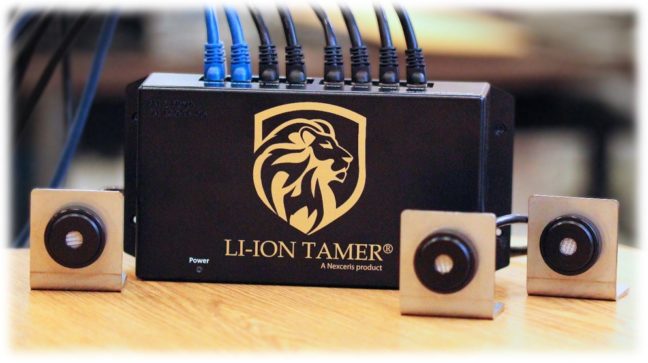
Li-Ion Tamer Gen 3 uses metal-oxide semiconductor (MOS) sensors specifically engineered to identify the volatile organic compounds released during lithium-ion cell venting. The system architecture includes three coordinated sensor types working through a hub-and-controller network:
1. Monitoring Sensors at the Racks
Off-gas sensors installed downstream of the convective airstreams from each battery rack — typically near rack air discharge points or within battery enclosures — continuously sample the air for electrolyte solvent vapors. Each monitoring sensor also reports ambient temperature and humidity for environmental context.
2. Reference Sensors at the Air Intakes
Reference sensors at the air intakes monitor the ambient environment for interfering particulate matter or background VOC concentrations from outside the protected space. The system compares monitoring sensor readings against reference baselines, dramatically reducing false alarms from non-battery VOC sources — diesel exhaust, cleaning chemicals, paint fumes, or other industrial vapors that might otherwise trigger a false detection.
3. Hubs, Controllers, and Communication
Sensors communicate to local hubs via CANbus, and hubs aggregate to a central controller. The controller processes signals using proprietary detection algorithms and provides output via Modbus, relay outputs, and Ethernet — allowing integration with the building’s fire alarm panel, battery management system, building management system, and SCADA infrastructure.
4. Three-Layer False Positive Protection
Li-Ion Tamer Gen 3 combines monitoring sensor signal evaluation, reference sensor baseline comparison, and algorithmic pattern recognition into a three-layer architecture that distinguishes true off-gas events from environmental interference. This addresses one of the historical challenges with VOC-based detection — maintaining sensitivity to real events while ignoring routine VOC presence from non-battery sources.
Why Is Li-Ion Tamer Chemistry-Agnostic?
One of the system’s most important engineering advantages is that it works across all major lithium-ion battery chemistries — NMC, NCA, LFP, LCO, LTO, and current production variants. Many fire detection systems require chemistry-specific tuning. Li-Ion Tamer does not.
The reason is chemical: lithium-ion cells use carbonate-based electrolytes regardless of cathode chemistry. When a cell begins to fail, the electrolyte breaks down and vents diethyl carbonate (DEC), dimethyl carbonate (DMC), and ethyl methyl carbonate (EMC) — the specific compounds Li-Ion Tamer is engineered to detect. These compounds are present in every modern lithium-ion failure mode, which means the same detection equipment works whether the installation uses LFP for grid storage, NMC for EV applications, or NCA for high-energy-density storage.
As BESS deployments increasingly diversify across chemistries — and as facilities mix chemistries within multi-vendor projects — chemistry-agnostic detection becomes operationally essential. The same Li-Ion Tamer infrastructure protects a facility through battery technology refreshes and chemistry transitions over the system’s full operational life.
Li-Ion Tamer Gen 3 Specifications and Certifications
| Attribute | Specification |
|---|---|
| Manufacturer | Honeywell (also branded under Notifier, Gent, Morley) |
| Detection target | Lithium-ion electrolyte solvent vapors (DEC, DMC, EMC) + thermal runaway gases (CO, H₂, hydrocarbons) |
| FM approval | FM 6540 Approved for Battery Electrolyte Solvent Vapours |
| UL / CSA listing | ETL listed to UL 61010 and CSA 22.2 NO. 61010 |
| Warning window | 2 to 30 minutes before thermal runaway, depending on failure mode |
| Battery chemistry compatibility | Chemistry-agnostic — NMC, NCA, LFP, LCO, LTO, all lithium-ion variants |
| Sensor calibration | Calibration-free MOS sensors; bump test verification with supplied DEC reference |
| Sensor lifetime | Comparable to lithium-ion battery system lifetime — minimizes replacement burden |
| Communication protocols | CANbus (sensor-to-hub), Modbus, dry contact relays, Ethernet |
| Operating temperature | Controllers: 0 to 40 °C; Sensors and Hubs: −10 to 50 °C |
| Deployment scale | Modular, containerized, and large-scale LIB installations |
The FM 6540 approval is particularly important for BESS owners: it is the dedicated FM Global approval standard for battery electrolyte solvent vapor detection, and FM Global Data Sheets reference it as the qualified detection technology for lithium-ion fire safety. AHJs, insurance underwriters, and registered design professionals increasingly require FM 6540 approved equipment for non-residential BESS installations.
How Does Li-Ion Tamer Support NFPA 855 (2026 Edition) Compliance?
The 2026 edition of NFPA 855 introduced substantial new requirements that directly affect detection technology selection for BESS installations:
- Hazard Mitigation Analysis (HMA) is now required for nearly all non-exempt installations — and the HMA must address the detection technology used to identify each credible failure scenario
- Large-Scale Fire Testing (LSFT) is now required alongside UL 9540A testing — establishing how the specific BESS behaves during real thermal runaway events
- Thermal Runaway Propagation Prevention (TRPP) is now defined as an active mitigation method under Section 9.7.6.6, requiring detection technology that can identify failure before propagation begins
- Combustible Concentration Reduction (CCR) systems under Section 9.7.6.7 require detection that can trigger ventilation before flammable gas concentrations accumulate
- Coverage expanded to 19 battery technologies — including iron-air, sodium-sulfur, zinc-bromide, and lithium metal — with dedicated requirements for each chemistry
- Flow batteries now have their own Chapter 16 with spill control and hazard mitigation provisions
- Emergency power supply systems (EPSS/SEPSS) must support critical safety systems including detection per NFPA 110 or NFPA 111
Li-Ion Tamer Gen 3 supports compliance across the full 2026 framework:
HMA Integration
The off-gas detection layer provides documented response capability for single-cell failure scenarios — the foundational HMA case. SSI participates in HMA development with the project’s fire protection engineer of record, providing the detection timing, response sequence, and integration documentation that supports the HMA conclusions.
TRPP Active Mitigation
Off-gas detection enables active TRPP — when a cell is identified as venting in Phase 2, the system can trigger ventilation, electrical isolation, and rack-level cooling before the failure cascades to adjacent cells. This is precisely the scenario the new Section 9.7.6.6 addresses.
CCR Coordination
Combustible Concentration Reduction requires that ventilation activate before flammable gas concentrations reach dangerous levels. Li-Ion Tamer detection triggers CCR ventilation at the off-gas stage — well before hydrogen or other combustible accumulation reaches lower flammability limits.
For deeper NFPA 855 compliance guidance: read our full NFPA 855 BESS compliance guide — detection, HMA, and the 2026 update →
Why Layered Detection Is the Industry Standard for BESS Fire Safety
No single detection technology is sufficient for a properly engineered lithium-ion fire safety strategy. Industry best practice — and increasingly, AHJ and insurance expectations — is a layered detection approach that combines technologies operating at different phases of the failure progression. Each layer provides defense-in-depth coverage if the layer above it misses or is delayed.
For a complete BESS installation, SSI typically engineers detection across four to five layers:
- Battery Management System (BMS) — voltage, current, and cell temperature monitoring from the battery system itself, identifying internal anomalies
- Thermal imaging — surface temperature monitoring identifying pre-ignition heat anomalies (Phase 1)
- Li-Ion Tamer off-gas detection — electrolyte solvent vapor detection (Phase 2)
- VESDA air sampling — incipient smoke detection (Phase 3)
- Video Fire Detection (VFD) and flame detection — confirmed fire detection (Phase 4)
- Conventional spot smoke and heat — code-baseline detection serving as the final supervised layer
Li-Ion Tamer is the critical middle layer — uniquely valuable because Phase 2 off-gas is the most actionable signal. Phase 1 thermal anomalies can be ambiguous (charging cycle? failing cell?). Phase 3 smoke means propagation has likely already begun. Phase 2 off-gas detection is unambiguous, chemistry-specific, and provides the operational window that matters: enough warning for evacuation, isolation, and intervention; specific enough that response protocols can be executed with confidence.
Where SSI Deploys Li-Ion Tamer
Li-Ion Tamer is the right detection choice for any facility with significant lithium-ion exposure where the consequences of a fire extend beyond a single piece of equipment. SSI engineers Li-Ion Tamer deployments across:
Utility-Scale and Behind-the-Meter BESS
Grid-scale storage installations, microgrids, and commercial BESS deployments operating under NFPA 855 (2026). Li-Ion Tamer is the foundation of the off-gas detection layer required to satisfy current HMA, TRPP, and CCR requirements. SSI handles design integration with the EPC, fire protection engineer of record, and AHJ across the project lifecycle.
Data Centers With Lithium-Ion UPS Backup
Data centers transitioning from VRLA to lithium-ion UPS gain operational and density advantages — and acquire a fundamentally different fire risk profile. Li-Ion Tamer monitors UPS battery cabinets and charging infrastructure continuously, providing the off-gas warning layer that VRLA-era detection strategies were never designed for. Integrates naturally with EPSMS for coordinated emergency shutdown.
EV Charging and Microgrid Infrastructure
Fast-charging installations with on-site battery buffering, EV charging hubs, and microgrid storage all combine lithium-ion exposure with public access — a particularly demanding combination from a fire safety standpoint. Off-gas detection inside charging enclosures provides the early warning that smoke-based detection in outdoor or semi-outdoor environments cannot reliably deliver.
Battery Manufacturing, Testing, and Recycling
Production lines, testing labs, R&D facilities, and recycling sorting operations all face elevated thermal runaway risk from damaged, defective, or end-of-life cells. Li-Ion Tamer provides facility-wide off-gas monitoring scaled to the production volume and chemistry mix.
Telecommunications and Network Operations Centers
Carrier facilities, switching centers, and network nodes increasingly using lithium-ion battery backup. The combination of mission-critical service requirements and the lithium-ion failure profile makes off-gas detection particularly valuable in these environments where any equipment loss has downstream service impact.
Warehouses With Lithium-Ion Forklift Charging
High-throughput distribution centers with concentrated lithium-ion forklift fleets and charging stations. Li-Ion Tamer monitors charging areas where defective packs, improper seating, or worn chargers represent ongoing fire risk that conventional warehouse smoke detection cannot reliably address.
How Does Li-Ion Tamer Integrate With Fire Alarm and Suppression Systems?
Li-Ion Tamer reaches its full value when integrated as a supervised detection input to the building’s fire alarm platform — not deployed as a standalone monitoring system. SSI engineers every Li-Ion Tamer installation with coordinated integration to:
- Fike fire alarm panels — Cheetah Xi and FCP series receive supervised Li-Ion Tamer inputs through relay and Modbus interfaces, enabling coordinated detection-to-response sequencing
- Autocall fire alarm systems — addressable integration through addressable input modules, with TrueSite graphical workstation visualization for multi-rack BESS installations
- Battery Management System (BMS) — coordinated isolation of affected racks, modules, or zones when off-gas is detected
- Building management systems (BMS) — BACnet integration for HVAC modification, ventilation activation, and access control coordination
- SCADA and PLC platforms — Modbus integration for industrial control systems and utility BESS monitoring
- Emergency power shutdown — coordinated activation of EPSMS infrastructure when escalation requires electrical isolation
- Suppression releasing systems — for clean agent, water mist, or other agent installations protecting the BESS, integration with Fike suppression panels for coordinated pre-discharge sequencing
- Mass notification systems — automatic occupant alerts when off-gas detection escalates to evacuation
- Remote monitoring — 24/7 central station notification with full event detail and integration with first responder communication
Frequently Asked Questions
What is Li-Ion Tamer?
Li-Ion Tamer is an off-gas detection system manufactured by Honeywell that identifies the volatile organic compounds released by lithium-ion battery cells when they begin to fail. By detecting electrolyte solvent vapors before thermal runaway begins, Li-Ion Tamer provides 2 to 30 minutes of advance warning — the most actionable detection window in lithium-ion fire safety. The current platform is Li-Ion Tamer Gen 3, which is FM 6540 approved and ETL listed.
How does Li-Ion Tamer detect battery failure before fire?
When a lithium-ion cell begins to fail, internal exothermic reactions cause the cell’s carbonate-based electrolyte to break down and vent into the surrounding air. Li-Ion Tamer’s metal-oxide semiconductor sensors detect the resulting electrolyte solvent vapors — diethyl carbonate, dimethyl carbonate, and ethyl methyl carbonate — at trace concentrations. This off-gas release occurs before any visible smoke or flame, providing the earliest detectable signal of impending failure.
How much warning time does Li-Ion Tamer provide?
Li-Ion Tamer typically provides 2 to 30 minutes of warning before thermal runaway begins. The actual lead time depends on the specific failure mode — slow-developing failures from internal cell shorts provide longer windows; faster failures from mechanical damage or severe electrical abuse provide shorter ones. In all cases, the off-gas signal appears before smoke or flame, providing a window for ventilation activation, electrical isolation, and emergency response.
Is Li-Ion Tamer compatible with LFP, NMC, and other battery chemistries?
Yes. Li-Ion Tamer is chemistry-agnostic and works with all major lithium-ion variants including LFP, NMC, NCA, LCO, and LTO. This is possible because the detection target — carbonate electrolyte solvents (DEC, DMC, EMC) — is common to all lithium-ion chemistries regardless of cathode composition. The same detection equipment works whether the installation uses LFP for grid storage, NMC for high-energy applications, or mixed chemistries across multi-vendor projects.
Is Li-Ion Tamer required by NFPA 855?
NFPA 855 does not mandate Li-Ion Tamer by name. It requires reliable fire detection appropriate to the installation, with the 2026 edition substantially strengthening detection expectations through HMA requirements, TRPP provisions, and CCR coordination. In practice, off-gas detection is the technology category that satisfies these requirements for lithium-ion BESS — and Li-Ion Tamer is the FM 6540 approved option most commonly specified by registered design professionals, AHJs, and insurance underwriters.
What is FM 6540 approval and why does it matter?
FM 6540 is the FM Global approval standard for detection of battery electrolyte solvent vapors. Equipment approved to FM 6540 has been tested and certified by FM Approvals as performing reliably for lithium-ion off-gas detection. FM Global Data Sheets reference FM 6540 approved equipment as the qualified technology for this application, and an increasing number of insurance underwriters and AHJs treat FM 6540 approval as a baseline requirement for lithium-ion BESS detection. Li-Ion Tamer Gen 3 holds current FM 6540 approval.
Does Li-Ion Tamer require calibration?
No. The Li-Ion Tamer Gen 3 metal-oxide semiconductor sensors are designed to be calibration-free over their operational life — which is engineered to be comparable to the lithium-ion battery system they protect. Periodic verification is performed using a bump test with a bottle of diethyl carbonate supplied by Honeywell. This eliminates the recurring calibration cost and downtime associated with many traditional gas detection technologies.
Can Li-Ion Tamer be retrofitted into an existing BESS or facility?
Yes. Li-Ion Tamer retrofits are common and typically straightforward. Sensors are mounted at rack air discharge points and intake areas without modifying the battery system itself. The hub-and-controller architecture connects to existing fire alarm panels through relay or Modbus interfaces. SSI evaluates existing installations, identifies the right sensor coverage approach, and stages installation to minimize operational impact — including for facilities being upgraded to meet NFPA 855 (2026) requirements.
How does Li-Ion Tamer compare to thermal imaging for battery detection?
Thermal imaging and Li-Ion Tamer detect different phases of the same failure progression and are complementary, not competing, technologies. Thermal imaging operates in Phase 1, detecting abnormal cell heating before any gas is vented. Li-Ion Tamer operates in Phase 2, detecting the chemical signature of cell venting. Most modern BESS installations deploy both as part of a layered detection strategy, with thermal imaging providing earlier but less specific warning and Li-Ion Tamer providing chemistry-specific confirmation that battery failure is in progress.
What happens when Li-Ion Tamer detects an off-gas event?
The response sequence is engineered for each specific installation but typically follows a defined escalation: detection of off-gas triggers an alarm at the fire alarm panel and operator console, which then activates ventilation to dilute potential accumulation, signals the battery management system to isolate affected racks where capability exists, alerts central monitoring and on-site personnel, and prepares connected suppression systems to release if escalation continues. The intent is to give human operators a defined window to investigate, isolate, and respond before the situation requires suppression.
How is Li-Ion Tamer tested and maintained?
Li-Ion Tamer maintenance is significantly lower than traditional gas detection. Sensors are calibration-free over their operational lifetime, with periodic verification via bump test using diethyl carbonate reference vapor. Annual inspection includes verification of sensor response, hub and controller function, integration with the fire alarm panel, and supervised circuit operation per NFPA 72 testing requirements. SSI provides annual service contracts that cover all required inspection, bump testing, and documentation.
The SSI Approach to Li-Ion Tamer Engineering
Li-Ion Tamer is most effective when designed as part of a complete fire safety strategy — not specified as a standalone product. SSI’s NICET-certified engineers handle the full lifecycle:
1. Hazard Assessment and Coverage Design
Site evaluation, battery chemistry review, airflow analysis, and rack-level sensor placement engineered for the specific installation. Reference sensor placement coordinated with the building’s ventilation infrastructure.
2. HMA Support Documentation
Detection technology specification, response timing analysis, and integration documentation supporting the Hazard Mitigation Analysis required under NFPA 855 (2026). Coordination with the fire protection engineer of record throughout HMA development.
3. Installation, Commissioning, and Integration
Factory-trained technicians handle sensor mounting, hub and controller configuration, network commissioning, fire alarm panel integration, BMS and SCADA interface verification, and full acceptance testing per the approved AHJ protocol.
4. Operator Training and Documentation
Facility staff training on alarm interpretation, response procedures, and bump test verification. Documentation provided in formats your operations team and the AHJ can actually use.
5. Annual Inspection and Service
NFPA 72 and NFPA 855 compliant annual inspection, bump testing, software updates, and supervisory verification. SSI maintains the system through its full operational life.
The Earliest Warning Matters Most. SSI Delivers It.
For battery energy storage, data centers, EV charging, and any facility with significant lithium-ion exposure, the difference between a controllable incident and a catastrophic loss often comes down to how early the failure is detected. Li-Ion Tamer Gen 3 delivers that detection — and SSI delivers the engineering, integration, AHJ coordination, and lifecycle service that turns the detection into a working fire safety strategy.
Contact SSI today to schedule a battery safety assessment, request a Li-Ion Tamer design consultation, or discuss NFPA 855 (2026) compliance for your project. We serve Pennsylvania, New Jersey, Maryland, Virginia, and Delaware.