
Dry Chemical Fire Suppression Systems
Rapid knockdown for severe industrial hazards, designed, installed, and maintained by SSI to align with NFPA 17 requirements.
NFPA 17 compliant dry chemical solutions for severe industrial hazards
- Rapid knockdown for Class A, Class B, and Class C fire risks
- Strong fit for flammable liquid, energized electrical, and spray operations
- Available as total flooding or local application designs
- Clear inspection, testing, and maintenance path under NFPA 17
At a Glance
Best use case
High consequence industrial hazards where speed matters more than residue, especially Class B flammable liquid scenarios.
Main tradeoff
Powder spreads widely and requires thorough cleanup after discharge, plan for downtime and restoration.
Common system styles
- Total flooding for enclosed hazards
- Local application for open or defined target hazards
If cleanup is unacceptable, compare residue free suppression options.
For occupied control rooms and high value electronics, dry chemical is rarely the right answer. Compare Clean Agent Fire Suppression for residue free alternatives when the hazard and code path allow.
How Dry Chemical Works
Dry chemical suppresses fire by interrupting the flame chemistry, stopping the chain reaction fast. The correct design depends on hazard class, fuel behavior, ventilation, enclosure boundaries, and how much operational downtime you can tolerate after a discharge.
Fast knockdown
Effective for severe Class B hazards where rapid control is the priority.
Designed discharge pattern
Nozzle layout and discharge timing must match the hazard geometry to be effective.
Post discharge reality
Cleanup and equipment restoration should be part of the decision, not an afterthought.
ABC vs BC Agents
ABC, Multi Purpose Agent
Monoammonium phosphate, broad coverage where ordinary combustibles are present along with liquid and electrical risk.
- Class A, ordinary combustibles
- Class B, flammable liquids
- Class C, energized electrical
BC, Liquid and Electrical Focus
Sodium or potassium bicarbonate, commonly selected for dedicated Class B and Class C hazards and many industrial applications where flow behavior and caking resistance matter.
- Class B, flammable liquids and gases
- Class C, energized electrical
- Often used where Class A involvement is minimal
Total Flooding vs Local Application
The discharge method is as important as the agent. It drives nozzle placement, enclosure requirements, and how the system is tested and maintained.
Total Flooding
Fills an enclosed hazard volume to a design concentration. Best when the hazard boundaries are defined and the enclosure can retain agent.
- Paint mix enclosures and storage bays
- Dedicated rooms with controlled openings
- Defined hazard volume with predictable air movement
Local Application
Discharges directly onto a defined hazard area. Best when full enclosure is not practical or when the hazard is open faced.
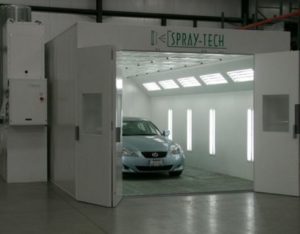
- Open face spray booths and dip tanks
- Conveyors, presses, and coating lines
- Equipment hazards with clear target zones
Ideal Applications and the Cleanup Tradeoff
- Paint spray booths and finishing operations
- Dip tanks and flammable liquid process areas
- Printing, converting, and coating equipment
- Flammable liquid storage and transfer zones
- Maintenance shops and heavy equipment hazards
- Fuel dispensing and unattended outlets
Important disclosure, downtime is part of the decision.
Dry chemical powder spreads widely and requires thorough cleanup after discharge. Expect more restoration effort than residue free systems. The tradeoff is often acceptable for severe Class B hazards where speed and coverage are the priority.
System Components, What You Are Actually Buying
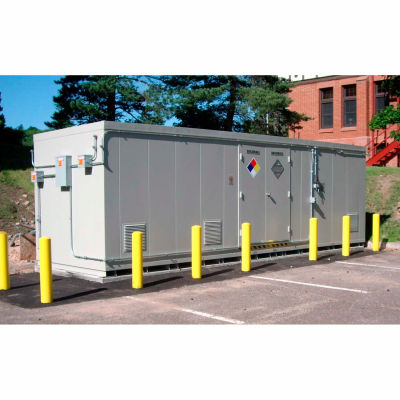
- Agent cylinders and expellant, sized to the hazard, enclosure, and nozzle design
- Detection and release, manual and automatic actuation aligned to the hazard scenario
- Distribution and nozzles, engineered for coverage, discharge time, and obstruction reality
- Interlocks, ventilation shutdown, equipment shutdown, alarms, and supervision where applicable
For broader system planning across special hazards, see Design Considerations for Special Hazards.
NFPA 17 Compliance and Maintenance Basics
Dry chemical systems are not a set it and forget it asset. Your inspection, testing, and maintenance plan is the difference between installed and ready. NFPA 17 provides the baseline expectations for dry chemical extinguishing systems.
Typical ITM cadence under NFPA 17
- Monthly owner inspection, verify cylinders, gauges, accessibility, and that hazard conditions have not changed
- Semi annual professional maintenance, functional checks, detection interface, discharge piping, and nozzles
- Six year internal examination, internal agent cylinder evaluation and recharge as required
- Twelve year hydrostatic testing, cylinders and hose assemblies per NFPA intervals
Code reference: NFPA, look for NFPA 17, Standard for Dry Chemical Extinguishing Systems.
Why Work With SSI
Industrial hazard focus
Dry chemical is chosen for high consequence hazards. SSI designs to real fuel behavior, airflow, and operating realities, not a generic diagram.
Lifecycle support
Design, installation, commissioning, and ongoing ITM so the system stays ready and defensible during audits and after facility changes.
Regional coverage
SSI supports special hazards across the East Coast, including PA, NJ, NY, MD, DE, VA, WV, OH, MA, CT, RI, NH, VT, and ME.
Related Resources
- Clean Agents, residue free options for occupied and electronics heavy spaces
- Specialty Water Suppression Systems, alternatives for specific industrial hazards
- Design Considerations for Special Hazards, planning and selection framework
- Fire Detection and Alarms, detection and signaling integration
- Special Hazard Fire Suppression, SSI overview for engineered protection
Dry Chemical Fire Suppression FAQ
What types of fires are dry chemical systems effective against?
Dry chemical systems control Class A, ordinary combustibles, Class B, flammable liquids, and Class C, energized electrical. ABC agent covers A, B, and C. BC agent targets B and C hazards.
What is the main disadvantage of a dry chemical system?
Dry chemical powder spreads widely and requires extensive cleanup after discharge. Expect more downtime and restoration work than residue free systems.
How often must a dry chemical system be serviced?
NFPA 17 typically calls for monthly owner inspection and semi annual professional maintenance, plus periodic internal examinations and hydrostatic testing at defined intervals.
Which agent is right for my hazard, ABC or BC?
ABC is often chosen when ordinary combustibles are part of the credible scenario. BC is commonly selected for dedicated liquid and electrical hazards where Class A involvement is minimal.
Next Steps
- Confirm your hazard type, fuel behavior, enclosure boundaries, and ventilation reality.
- Choose agent and discharge method that matches the hazard and acceptable downtime.
- Engineer nozzle placement and interlocks, then document the inspection and maintenance plan.
- If residue is unacceptable, compare alternatives on the Clean Agents page.
Talk with SSI about your dry chemical code path and design.
We will review the hazard, recommend the correct system type, and map out an ITM plan aligned to NFPA expectations so the system stays ready over time.
Request a consultation or call 1-800-360-0687 .