
Home > Fire Suppression > ECARO-25, FE-25, HFC-125
ECARO-25, FE-25, HFC-125 Clean Agent Fire Suppression
Clean agent protection for mission-critical rooms and special hazards where water damage is not an option. ECARO-25 is a halocarbon clean agent used to suppress fires quickly, without residue, helping reduce downtime and collateral damage in high-value environments.

Suppression Systems, Inc. (SSI) designs, installs, and maintains clean agent systems across Pennsylvania and the East Coast, including Pennsylvania, New Jersey, New York, Delaware, Maryland, Virginia, and beyond. If you are comparing agents, planning a retrofit, or preparing for an acceptance test, talk with an SSI specialist.
Request a clean agent consultation | Explore all clean agent solutions | Room integrity guidance, Door Fan Test
ECARO-25 at a glance
- Clean agent suppression, no residue, no corrosive cleanup.
- Fast discharge, engineered to reach design concentration quickly for special hazard protection.
- Electronics-friendly, often used in data centers, control rooms, UPS rooms, and switchgear spaces.
- Design and code compliance, built around applicable clean agent requirements and AHJ expectations.
- Lifecycle support, design, installation, inspections, testing, maintenance, and system upgrades.
What are ECARO-25, FE-25, and HFC-125
ECARO-25, also referenced as FE-25 and HFC-125, is a clean agent used in total flooding fire suppression systems. In protected enclosures, the agent is stored in cylinders and discharged through engineered piping and nozzles when detection and releasing controls activate.
Clean agents are commonly selected for hazards where water discharge can create unacceptable damage, extended downtime, or difficult cleanup. If your space is occupied or intermittently occupied, system design must include appropriate safety devices and procedures, and must follow applicable codes and approval requirements.
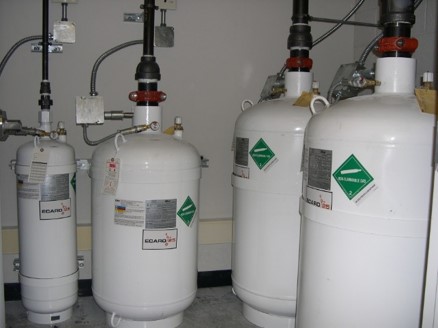
Why this matters: cylinder layout, discharge piping, nozzle coverage, and enclosure integrity all affect performance during commissioning and acceptance testing.
How ECARO-25 clean agent systems suppress fire
A properly engineered clean agent system is designed to achieve and hold a target concentration long enough to control the fire and help prevent re-ignition. Performance depends on hazard type, room volume, obstructions, discharge time, and enclosure leakage.
- Detection, initiating devices identify smoke, heat, or flame conditions based on the hazard and design goals.
- Release and discharge, the system opens the cylinder valve and distributes agent through engineered nozzles.
- Enclosure integrity, the room must retain the agent concentration for the required hold time, leakage control is critical.
Where ECARO-25 is commonly used
ECARO-25, FE-25, HFC-125 systems are often applied in clean, high-value, or continuity-critical environments, including:
- Data centers and server rooms, racks, network rooms, UPS rooms, and electrical rooms.
- Control rooms and critical process areas, where downtime risk and equipment loss are high.
- Telecom and command spaces, where residue-free suppression is preferred.
- Special hazard enclosures, where sprinklers may not be the right tool for the risk.
If you are evaluating alternatives, SSI also supports other clean agent and special hazard technologies, including SF 1230 clean agent systems, ProInert2 inert gas systems, and specialty water-based options such as Fike DuraQuench Pro, Fike Micromist, and Victaulic Vortex.
Room sealing and hold time, a frequent cause of failed acceptance tests
Clean agent systems depend on the enclosure performing like an enclosure. If leakage is excessive, the agent concentration can fall below the level required to control the fire, especially in the upper portions of the room. That is why room sealing and room integrity testing are common requirements for clean agent projects.
- Penetrations, cable trays, conduits, and pipe sleeves often require sealing and firestopping strategies.
- Doors, automatic door bottoms and perimeter gasketing are common leakage fixes.
- Ceilings and wall construction, slab-to-slab continuity or equivalent detailing can be important depending on design.
- HVAC and dampers, duct openings and automatic closures can affect performance and safety.
See SSI guidance on proper sealing of clean agent rooms if you are preparing for a Door Fan Test or troubleshooting a failed hold time result.
Fire suppression planning, HFC phasedown, and long-term decisions
Many facilities are actively reviewing clean agent choices for long-term lifecycle planning, availability, and compliance. SSI helps owners and project teams evaluate technical fit, serviceability, and project risk, including how policy trends may affect future planning.

For helpful references, review the official EPA resources linked below, and if you need practical guidance for a project, contact SSI for an engineering-level recommendation based on your hazard, occupancy, and uptime goals.
Why SSI for ECARO-25 systems
- Special hazard experience, clean agent projects require careful integration of detection, controls, discharge, and enclosure performance.
- Code-aware design and commissioning, documentation and acceptance readiness for AHJ and insurer expectations.
- End-to-end support, from concept and design to installation, testing, maintenance, and retrofit planning.
- Integrated safety coverage, SSI also supports fire alarms and advanced detection, explosion protection, and special hazard consulting.
Related SSI capabilities: Fire alarms and detection, VESDA very early smoke detection, Industrial explosion protection, Special hazard design considerations.
Downloads and resources
Frequently asked questions
What is the difference between ECARO-25 and FE-25
ECARO-25 and FE-25 are commonly used names associated with HFC-125 clean agent systems. If you are comparing options, SSI can help confirm the exact system requirements and documentation for your project and authority having jurisdiction.
Does an ECARO-25 clean agent system require a sealed room
Clean agent performance depends heavily on enclosure integrity. Excessive leakage can reduce concentration and shorten hold time, increasing the risk of re-ignition. SSI provides practical room sealing guidance and integrity testing support.
Is ECARO-25 suitable for data centers and electronics
Clean agent systems are commonly selected for electronics-heavy environments because they are residue-free and avoid the widespread water damage associated with sprinklers. Final suitability depends on the hazard, occupancy, and engineered design.
How do I choose between clean agent, inert gas, CO2, and water mist
The best technology depends on occupancy, hazard type, enclosure constraints, environmental goals, and operational risk tolerance. SSI can compare technologies and recommend a compliant solution aligned with your facility priorities.
Talk with an SSI specialist
If you are planning a new clean agent system, troubleshooting a Door Fan Test, or evaluating lifecycle options, SSI can help you move from uncertainty to a defensible, code-aware plan.
Request a quote or engineering consult | Call: 1-800-360-0687