
Why Conventional Smoke Detectors Fail in High-Bay Warehouses — and What Actually Works
Warehouse fires move fast. Racking systems, cardboard, plastics, and high-density storage create fire loads that can escalate from ignition to full-room involvement in minutes. The fire alarm system protecting that environment should be one of the strongest assets in your fire protection plan.
For many warehouses and distribution centers, it isn’t. Conventional ceiling-mounted smoke detectors — the standard in most commercial buildings — have fundamental physical limitations in high-bay, high-airflow environments that compromise their ability to detect fire early enough to make a meaningful difference.
This page explains exactly why, what NFPA 72 says about the problem, and which detection technologies are engineered to work where conventional detectors struggle.
Suppression Systems, Inc. (SSI) designs and installs advanced fire detection systems — including Video Fire Detection (VFD) — for warehouses, distribution centers, and large industrial facilities across Pennsylvania, New Jersey, Maryland, Virginia, and Delaware.
The Physics Problem: Why Smoke Doesn’t Reach the Ceiling
A conventional ceiling-mounted smoke detector works by waiting for smoke particles to physically reach the sensor. In a standard office or commercial building with 9- to 12-foot ceilings, this happens quickly. Smoke rises in a column, hits the ceiling, spreads horizontally, and reaches a detector in short order.
In a warehouse with 30-, 40-, or 50-foot clear heights, that physics breaks down in three specific ways:
1. Thermal Stratification
As a fire develops, hot combustion gases rise rapidly — but in a tall space, the upper air mass is already warm from solar gain and HVAC activity. When the rising smoke plume hits a layer of warm air that is the same temperature or warmer, it stops rising. It stratifies — spreading horizontally far below the ceiling, well away from any detector mounted up top. A fire can be well-developed at floor level while the ceiling sensors read normal.
2. Dilution by High Airflow
Large warehouses typically have substantial HVAC systems — rooftop units, unit heaters, dock ventilation, and exhaust fans moving significant air volumes through the space. That airflow dilutes smoke concentrations and disperses the plume laterally before it can rise to ceiling level in sufficient concentration to trigger a point detector. Loading dock doors that open frequently add to this problem, creating pressure differentials that further disrupt smoke movement patterns.
3. Detection Coverage Gaps from Racking Obstruction
High-bay racking systems — particularly narrow-aisle configurations with 30- to 40-foot vertical storage — physically obstruct the smoke plume path. A fire igniting deep in a storage aisle may be surrounded by product on three sides and above. The smoke rises within the rack structure, hits the top shelf level, and spreads within the rack — far from the ceiling-level detectors that would need to sense it. NFPA 25 and NFPA 13 both recognize this issue for sprinkler systems; the same obstruction problem applies to smoke detection.
The result: In a high-bay warehouse with conventional ceiling-mounted detectors, fire can develop significantly — and visible flame may already be present at lower levels — before any detector activates. The alarm that should give your team and your sprinkler system time to respond may not come until the fire has already reached a scale that makes early intervention impossible.
What NFPA 72 Says About High-Bay Detection
NFPA 72 — the National Fire Alarm and Signaling Code — directly addresses the limitations of spot detection in large, open, and high-ceiling spaces. The code recognizes that ceiling height, beam construction, airflow patterns, and structural obstructions all affect detector placement requirements and performance.
Key NFPA 72 provisions relevant to warehouse and high-bay environments include:
- Adjusted detector spacing requirements as ceiling height increases — standard spacing tables for spot detectors are developed for lower ceilings and do not directly apply in high-bay spaces without engineering review
- Recognition of Video Fire Detection (VFD) as a listed detection technology under NFPA 72 — camera-based flame and smoke detection is explicitly recognized as a compliant alternative to spot detection where spot detectors cannot provide reliable coverage
- Requirements for engineering analysis when environmental conditions — including high airflow, stratification risk, and obstructions — may compromise spot detector performance
- Beam detector provisions for wide open spaces, with specific spacing and sensitivity requirements different from point detectors
The practical implication: if your warehouse has ceiling heights above 30 feet, significant HVAC airflow, or high-bay racking systems, a spot-detector-only design may not provide the reliable coverage NFPA 72 intends — and an engineering review of your detection approach is warranted.
Conventional Detectors vs. High-Bay Realities
This table maps the common characteristics of warehouse and distribution center environments against the specific failure modes of conventional spot detection:
| Environment Characteristic | How It Compromises Spot Detection |
|---|---|
| Ceiling height 30 ft or greater | Smoke stratifies before reaching ceiling; detector may not activate until fire is well-developed |
| High HVAC airflow / large unit heaters | Smoke plume dispersed and diluted; concentration at detector falls below activation threshold |
| High-bay racking (30–40 ft vertical storage) | Fire deep in rack aisle is physically shielded from ceiling detectors by product and structure |
| Frequently open loading dock doors | Pressure differentials disrupt smoke movement patterns; plume may exit building before reaching detector |
| Steel beam / truss construction with irregular ceiling surface | Structural pockets trap smoke in isolated areas; horizontal spread to detectors is impeded |
| Large open floor area (100,000+ sq ft) | Detector spacing requirements increase; coverage gaps become more significant at standard point-detector densities |
| Mixed storage including plastics and expanded foam | Fast-developing, high-heat fires produce rapid flame development before significant smoke; spot heat detectors may also respond late |
What Actually Works in High-Bay Warehouses
The detection technologies that overcome these physical limitations share one characteristic: they don’t wait for smoke or heat to travel to a fixed point sensor. They monitor the environment directly — and they detect fire events at or near the level where the fire is developing, not 40 feet above it.
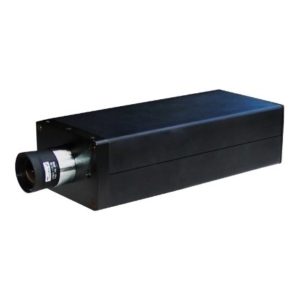
Video Fire Detection (VFD)
VFD uses cameras positioned at height to continuously monitor the protected space using AI-driven image analytics. The system identifies the visual characteristics of flame and smoke — brightness changes, movement patterns, flicker signatures — at the level where they are actually occurring, not at ceiling height.
- Detects flame and smoke visually — independent of whether smoke reaches the ceiling
- AI filtering — differentiates real fire signatures from steam, welding, forklift exhaust, and sunlight reflections that routinely cause false alarms with conventional detectors
- Wide-area coverage — a single camera covers a large floor area, including deep within rack aisles when properly positioned
- Visual verification — operators see the event in real time, confirming before dispatching response
- NFPA 72 listed — recognized as a compliant detection technology for environments where spot detectors are inadequate
Thermal Imaging Detection
Thermal imaging goes a step further — detecting heat signatures and temperature anomalies before ignition occurs. Infrared sensors monitor temperature across critical assets and flag hot spots that indicate developing fire risk. For warehouses storing temperature-sensitive goods, lithium-ion battery charging areas, or facilities with conveyor systems prone to overheating, thermal imaging can identify the problem before flame or smoke develops at all.
- Pre-ignition detection — identifies heat anomalies before visible flame or smoke
- Continuous 24/7 monitoring — operates in dusty, humid, or low-light conditions where cameras may be limited
- Ideal for high-risk storage areas — battery charging, coal storage, conveyor systems, and electrical rooms within warehouse environments
Linear Heat Detection for Rack Storage
For facilities with in-rack sprinkler requirements or high-value rack storage, linear heat detection cable can be routed within rack structures — detecting heat at the level where fire is actually developing, not 30 feet above it. It is the only point-of-fire detection technology that can practically be installed within the rack structure itself.
- Continuous cable-based detection along any path — including rack uprights and conveyor runs
- Not affected by airflow, ceiling height, or smoke stratification
- Compatible with Fike and Autocall alarm panels for integrated system design
Warehouse and Distribution Environments Where This Applies
The detection challenges described above are most pronounced in specific facility types. If your operation fits any of these categories, a review of your current detection approach is warranted:
| Facility Type | Primary Detection Risk Factor | Recommended Technology |
|---|---|---|
| High-bay fulfillment center | Stratification, rack obstruction, high HVAC airflow | VFD + linear heat in rack |
| Cold storage / refrigerated warehouse | Extreme temperature differential; conventional detectors unreliable in freezer environments | Thermal imaging, linear heat |
| Manufacturing and assembly plant | Process heat, welding activity causing nuisance alarms, high ceiling | VFD with AI false alarm filtering |
| Aircraft hangar | Extreme ceiling height, hangar door openings, jet exhaust interference | VFD, optical flame detection |
| Recycling and waste processing | Dust, debris, airborne particulate causing detector contamination | VFD, thermal imaging |
| Distribution center with Li-ion battery charging | Thermal runaway risk; pre-ignition heat signature precedes visible smoke | Thermal imaging, Li-Ion Tamer |
Signs Your Current Detection System May Not Be Adequate
Warehouse and facility managers often don’t know their detection system has coverage gaps until something goes wrong. These are the warning signs worth taking seriously:
- Your facility has ceiling heights above 30 feet and relies entirely on ceiling-mounted spot smoke detectors
- Your fire alarm system was designed for a previous use of the building and has not been reviewed since the facility was converted to warehouse or distribution use
- You have experienced frequent nuisance alarms — a signal that detectors are mismatched to the environment and may also be less reliable at detecting real fire events
- Your facility has added high-bay racking systems since the original fire alarm design was completed
- Your insurer or AHJ has raised questions about detection adequacy during recent inspections
- You have a sprinkler system but no early warning detection above the racking — relying on sprinkler activation as the first signal of a fire
- Your HVAC system has been significantly upgraded or expanded since the original fire alarm design
Any one of these is a reason to have your detection system reviewed by an engineer. SSI conducts fire detection system evaluations and can identify whether your current approach provides reliable early warning or leaves coverage gaps that a different technology would close.
SSI Designs High-Bay Detection Systems That Actually Work

Suppression Systems, Inc. specializes in fire detection systems for environments where standard designs fall short. We assess ceiling heights, airflow patterns, racking configurations, storage types, and occupancy before recommending a detection approach — because the right technology for a 12-foot office ceiling is not the right technology for a 45-foot distribution center.
Our VFD and thermal imaging systems integrate directly with Fike fire alarm panels and Autocall TrueSite Workstations — providing centralized, graphical monitoring that gives operators immediate visual confirmation of any event, anywhere in the facility.
We serve facilities across Pennsylvania, New Jersey, Maryland, Virginia, and Delaware, and handle everything from initial detection design through installation, commissioning, and long-term service.
Have a warehouse or high-bay facility with detection questions? Contact SSI today to schedule a detection system review or discuss a new installation with our engineers.
Related SSI Resources
Video and Advanced Detection:
- Video Fire Detection (VFD) Systems — Full Overview
- Advanced Fire Detection Systems at SSI
- Linear Thermal Detection
- Optical Flame Detection
- Industrial Thermal Imaging
- Li-Ion Tamer — Lithium-Ion Battery Detection
Fire Alarm Panels That Integrate VFD:
Related Fire Alarm and Suppression: