
The Accidental EPO Press: Why the “Big Red Button” Is Still One of the Biggest Risks in Your Data Center
In the long history of data center outages, a surprising number trace back to a single moment: someone, somewhere in the facility, pressed the Emergency Power Off button when they shouldn’t have. A contractor mistook it for a door release. A new technician bumped it with a ladder. A cleaning cart rolled into it. A visitor pressed it out of curiosity. The result is the same every time — every server, every UPS, every cooling unit in the protected space loses power within seconds.
The recovery isn’t measured in minutes. It’s measured in hours of phased restart, cold cache rebuild, replication catch-up, and customer-facing service restoration. For some facilities, it’s measured in days.
Accidental EPO activation is one of the most preventable causes of major data center downtime — and the prevention is engineering, not awareness training. This page explains why accidental presses happen, what the consequences look like, and what a properly engineered Emergency Power Shutdown Management System (EPSMS) does to make sure the EPO only activates when it’s supposed to.
Suppression Systems, Inc. (SSI) designs and installs intelligent EPSMS solutions across Pennsylvania, New Jersey, Maryland, Virginia, and Delaware — replacing legacy “big red button” hardware with logic-controlled, NFPA 70 and NFPA 75 compliant shutdown management.
Why EPOs Exist — and Why They Became a Liability
Emergency Power Off systems exist for a real, code-driven reason. NFPA 70 (NEC) Article 645.10 requires that IT equipment rooms have a means of disconnecting power to all electronic equipment and dedicated HVAC systems serving those spaces. The intent is clear: in a fire, electrical fault, or hazardous incident, first responders need a single, reliable way to de-energize the room before they enter.
The traditional implementation — a large, recognizable EPO button at the room’s entry points, wired through a relay to shunt trip the main breakers — does meet the code requirement. But the same characteristics that make an EPO effective for emergency response (visibility, accessibility, instant activation) are exactly what make it vulnerable to accidental activation during normal operations.
A button that anyone can press, that’s mounted at chest height near the door, with no confirmation, no time delay, and no validation logic, is a button that will eventually be pressed by accident. The only questions are when, by whom, and at what cost.
The engineering challenge: Maintain the code-required emergency shutdown capability — the EPO must work, instantly, when it needs to — while making it effectively impossible to activate by accident. A modern EPSMS solves this. A traditional EPO button does not.
How Accidental EPO Presses Actually Happen
The causes of accidental activation are remarkably consistent across facilities and industries. They are not exotic failure modes. They are routine, human-scale events that happen during normal operations.
1. Mistaken Identity at the Door
The most common scenario. A visitor, contractor, or new employee approaches a data center door and looks for the exit release button. Their eyes land on a large red button mounted near the door at the right height. They press it. The data center goes dark. Door release buttons and EPO buttons are often physically similar — and both are usually red — and human pattern-matching fills in the gap.
2. Physical Contact From Equipment, Carts, or Tools
A rack being rolled into position. A cleaning cart navigating tight aisles. A ladder set up against a wall during cabling work. An equipment case set down on a desk. A toolbox swung against the wall. Any one of these can press an unguarded EPO button mounted at typical wall-button height. The button does its job — it activates immediately. The fact that the activation was unintentional doesn’t change the result.
3. Wiring Faults and False Activation
Traditional EPO circuits often use normally-closed contacts that trip when the circuit is broken — meaning a wiring fault, a corroded contact, a damaged conductor, or even a power loss to the EPO relay itself can simulate a button press and trip the breakers. The system is designed to be fail-safe in the emergency response sense, but the same logic that makes it fail safe also makes it vulnerable to false trips from non-emergency causes.
4. Misunderstanding of the Button’s Function
A common operational scenario: a technician notices a problem with a single server or rack and looks for a way to shut down that specific equipment. The EPO is the nearest, most accessible “power off” looking control. Pressed in the belief that it shuts down “that thing over there.” It shuts down everything.
5. Curiosity, Especially During Tours
Data centers host visitors — customers, prospects, auditors, executives. Despite signage and verbal warnings, the prominent red button is a magnet for hands. “What does this do?” has, in published industry incidents, led directly to “you just shut down the whole facility.”
6. Maintenance Work Near the Button
Electricians replacing nearby fixtures. Drywall repairs. Painting. Sensor cleaning. Cable tracing along the wall near the EPO. Tools, hands, drop cloths, and ladders moving in close proximity to an unguarded button. The probability of contact increases sharply during any work in the surrounding wall area.
7. Malicious Activation
The least common but most concerning category — a disgruntled employee, a former employee with retained access, or in some published cases, an external person who gained entry. An unguarded, single-press EPO offers no resistance to intentional sabotage. Two-step activation logic, alarmed covers, and access logging are baseline protections against this category.
The Real Cost of an Accidental Shutdown
The button press takes a fraction of a second. The recovery does not. Beyond the immediate loss of service, the cascading effects of a sudden full-facility power loss extend through hardware, data, operations, and customer relationships.
| Consequence | What It Means in Practice |
|---|---|
| Total facility outage | All servers, all UPS systems, all cooling units lose power simultaneously — not a graceful shutdown |
| Hardware damage | Sudden power loss can damage hard drives, RAID arrays, and equipment that doesn’t tolerate ungraceful shutdown |
| Data corruption | In-flight transactions, unsynced replicas, and write-buffered data may be lost or corrupted; database recovery and integrity verification add hours |
| Extended restart sequence | Restoring service requires phased power-up — cooling first, then network, then storage, then compute — each phase taking time to stabilize |
| Cache and state rebuild | Applications with warm caches, in-memory state, or replication lag require extended catch-up before performing at normal levels |
| SLA violations | Customer-facing service downtime triggers SLA penalties, contractual remediation obligations, and credit issuances |
| Reputation impact | Major data center outages — especially preventable ones — receive industry press attention and become reference incidents for years |
| Forensic investigation | Insurance, contractual obligations, and internal accountability all require a documented root cause analysis before the incident is closed |
The hardest part of communicating the value of a properly engineered EPSMS is that the avoided cost is invisible — facilities that prevented the press never experienced the outage they would have had. Facilities that did experience an accidental press, on the other hand, almost universally end up replacing the EPO infrastructure within a year, because their leadership has been viscerally educated in why the alternative matters.
How a Properly Engineered EPSMS Prevents Accidental Activation
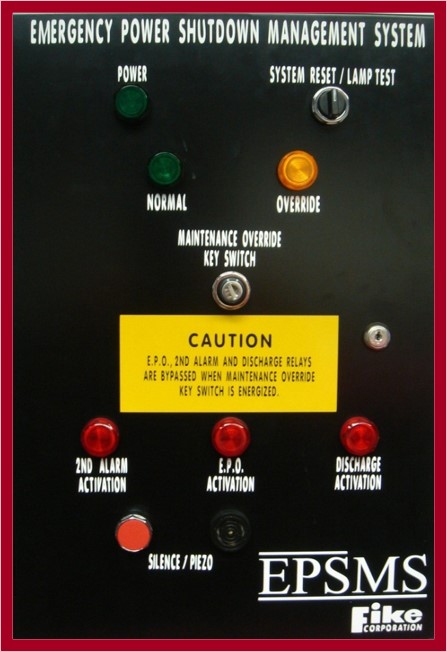
The goal of a modern EPSMS is precisely defined: maintain the code-required emergency shutdown capability — instantly responsive when actually needed — while engineering out every common cause of accidental activation. SSI accomplishes this through layered protection at three levels: the physical interface, the activation logic, and the wiring topology.
Physical Protection at the Button
- Recessed mounting — buttons set into the wall or panel below the surface plane, eliminating accidental contact from passing equipment, carts, or shoulders
- Hinged alarmed covers — clear plastic covers that audibly alarm when opened, requiring a deliberate two-step action and signaling intentional activation to security and operations
- Guarded button rings — physical guards that prevent palm presses, tool contact, and incidental object pressure
- Differentiated mounting locations — separated visually and physically from door release buttons, light switches, and other controls that could be confused with the EPO
- Clear, contrasting signage — explicit labeling identifying the button as Emergency Power Off, with consequences clearly stated
Activation Logic at the Controller
- Two-step activation (A/B confirmation) — requires two independent button presses, either in sequence or simultaneously, before the shutdown sequence initiates
- Timed activation logic — requires the button to be held for a configurable period before activation, preventing momentary contact from triggering shutdown
- Cross-zoned confirmation — for facilities with multiple EPO stations, requires confirmation from two stations or a station-plus-fire-alarm event before activation
- Programmable delay and abort window — a configurable countdown period during which an authorized operator can abort the shutdown if pressed in error
- Audible pre-shutdown warning — alerts everyone in the protected space that shutdown is imminent, providing the operator with an opportunity to intervene
Power-On Trip Logic at the Wiring
- Power-on trip configuration — the system requires positive voltage to initiate shutdown, not absence of voltage; a wiring fault or power loss cannot simulate an EPO press
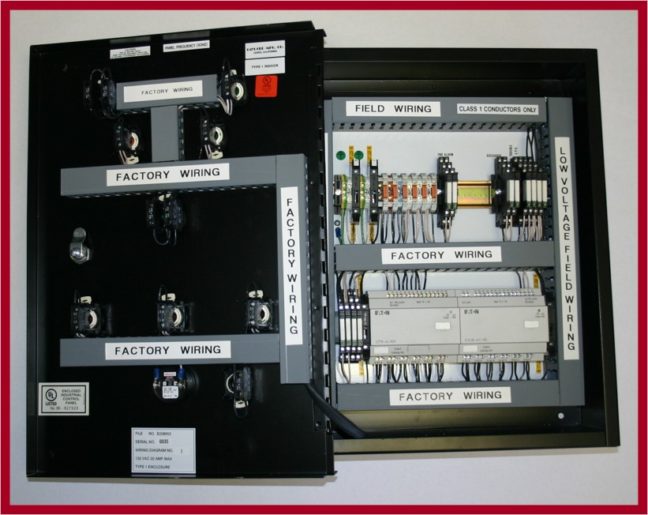
- Supervised circuits — the control wiring is continuously monitored; any fault, short, or open is annunciated as a trouble condition, not a shutdown event
- Shunt trip breaker integration — the controller manages shunt trip breakers via 24VDC or 120VAC control voltage, with clearing contacts that protect the coils from burnout
- Undervoltage release (UVR) option — available where the application calls for it, but engineered to coordinate with the controller rather than create independent trip risk
- Logged and supervised activation — every press, fault, abort, and shutdown is logged with timestamp and source, providing complete forensic visibility
Which Facilities Should Consider an EPSMS Upgrade?
If any of these conditions describe your facility, an evaluation of the current EPO infrastructure is warranted:
- Your EPO is a single-press, unguarded button — no cover, no two-step logic, no time delay
- You have multiple EPO buttons in the facility with no coordination logic between them
- The EPO is mounted near a door in a location where it could be mistaken for a door release
- The EPO is in a high-traffic area where carts, ladders, or equipment routinely pass close to the button
- You host visitors, customers, or tours in the protected space
- Your facility has experienced a near-miss where someone almost pressed the EPO accidentally
- You’ve experienced an actual accidental activation and the corrective action has been operational training rather than engineering changes
- Your EPO has never been integrated with the fire alarm system for coordinated, supervised shutdown during fire events
- Your AHJ or insurance underwriter has flagged the EPO design during a recent inspection
- Your facility was built under an older NEC edition and the EPO infrastructure has not been reviewed against current best practices
The Fire Alarm Integration Side
A complete EPSMS isn’t just protection against accidental presses. It is also the controlled, coordinated shutdown mechanism during a confirmed fire or suppression event — engineered to interact properly with the fire alarm panel, the clean agent suppression system, and the building management infrastructure.
In a properly integrated installation, the sequence during a verified fire event looks like this:
- Fire alarm panel receives confirmed detection (typically cross-zoned in a clean agent space)
- Pre-discharge alarm and time delay activate, alerting occupants and providing the abort window
- HVAC shutdown command issued; dampers close to contain agent and prevent fire spread
- Clean agent suppression system discharges into the protected space
- EPSMS receives confirmed activation signal from the fire alarm panel and initiates the controlled electrical shutdown sequence
- Shunt trip breakers operate in the correct order; UPS battery disconnects per UL 1778-2 requirements
- Event logged across all systems with timestamps for post-incident review
For details on integrated detection and suppression, see Fire Alarm and Suppression System Integration — A Practical Guide.
Frequently Asked Questions
Is the EPO button required by code?
Yes. NFPA 70 (NEC) Article 645.10 requires that information technology equipment rooms covered by Article 645 provide a means to disconnect power to all electronic equipment in the room and to disconnect dedicated HVAC systems serving the room. The code requires the disconnecting means; it does not require a specific button design. A properly engineered EPSMS satisfies the code while preventing accidental activation.
Can we just put a cover on our existing EPO button?
A hinged alarmed cover is one element of accidental activation prevention, and it provides meaningful protection. But a cover alone does not address the deeper risks — single-point wiring failures, false trips from supervisory faults, lack of confirmation logic, missing fire alarm integration, or no event logging. A cover is an improvement; an EPSMS is the engineered solution.
What is power-on trip logic and why does it matter?
Power-on trip logic means the system requires positive voltage to initiate a shutdown. Traditional EPO circuits often use normally-closed contacts, where any break in the control circuit — a wiring fault, a corroded contact, a loss of supervisory power — appears identical to a button press and triggers the shutdown. Power-on trip eliminates this category of false activation by requiring an active, validated voltage signal to trip the breakers.
Will an EPSMS slow down emergency response?
No. Two-step activation, time delays, and abort windows are engineered to add fractions of a second to a deliberate emergency activation — well within the response timeframes required by NFPA 70 and NFPA 75. The protection is against momentary, accidental, or non-emergency activation, not against genuine emergency response. The EPO still works exactly as intended when actually needed.
Does my insurance carrier care about EPSMS?
Increasingly, yes. Business interruption underwriters reviewing data center operations are aware of accidental EPO activation as a documented loss category. Some carriers have begun applying premium adjustments or coverage conditions based on EPO infrastructure quality. An engineered EPSMS — with documentation of two-step logic, supervised wiring, fire alarm integration, and event logging — is a defensible position with underwriters in a way that a single unguarded button is not.
Can EPSMS be retrofitted into an existing data center?
Yes. EPSMS retrofits are routine and can be staged to avoid service disruption. The existing shunt trip breakers are typically reused; the EPO buttons, control wiring, and the EPSMS controller are replaced. Fire alarm integration is added or upgraded as part of the project. SSI handles the engineering, coordination with the AHJ, and staged installation to minimize impact on facility operations.
Is EPSMS only for data centers?
No. While data centers are the most common application due to NEC Article 645 requirements, EPSMS is also deployed in MRI suites, laboratory equipment rooms, broadcast facilities, manufacturing control rooms, and any environment where coordinated, code-compliant electrical shutdown is required and accidental activation must be prevented. SSI can evaluate your facility’s specific requirements.
Stop Waiting for the Accidental Press. Engineer It Out.
Most data centers that experience an accidental EPO activation respond by upgrading their EPO infrastructure within months. The opportunity is to make that upgrade before the incident — not after.
SSI evaluates existing EPO installations, identifies accidental activation risk factors, and engineers EPSMS solutions that maintain full code compliance while removing the vulnerabilities. We coordinate with your electrical contractor, AHJ, and operations team to deliver the upgrade on the schedule your facility can support.
Contact SSI today to schedule an EPO risk evaluation or discuss an EPSMS upgrade with our certified engineers. We serve Pennsylvania, New Jersey, Maryland, Virginia, and Delaware.