
NFPA 855 Compliance for Battery Energy Storage Systems: A Practical Guide for BESS Owners and Developers
NFPA 855 — Standard for the Installation of Stationary Energy Storage Systems — is the central fire safety code governing battery energy storage system (BESS) installations in the United States. The standard establishes requirements for system sizing, separation distances, ventilation, detection, suppression, and emergency response planning. Compliance is enforced through the local Authority Having Jurisdiction (AHJ), and the requirements are tightening with each code cycle following high-profile BESS fire incidents.
For BESS owners, developers, EPC firms, and facility operators, NFPA 855 is the foundation document — but the practical compliance path involves multiple overlapping requirements: UL 9540A testing for the battery system, a Hazard Mitigation Analysis (HMA) defining the response to credible failure scenarios, detection technology that can identify thermal runaway before propagation, and integrated suppression and emergency response infrastructure.
Suppression Systems, Inc. (SSI) designs and installs the fire detection, suppression, and emergency response infrastructure required for NFPA 855 compliant BESS installations across Pennsylvania, New Jersey, Maryland, Virginia, and Delaware. Our NICET-certified engineers handle the detection technology selection, HMA support documentation, AHJ coordination, and integrated system delivery from initial design through annual inspection.

What Is NFPA 855?
NFPA 855 is the National Fire Protection Association standard governing the installation of stationary energy storage systems — including lithium-ion battery installations, flow batteries, lead-acid systems, and other electrochemical, mechanical, and thermal storage technologies. First published in 2020 and updated in subsequent cycles, the standard reflects lessons learned from real-world BESS fire incidents and the evolving understanding of thermal runaway behavior.
The standard applies to:
- Grid-scale BESS installations — utility-scale storage at substations, generation sites, and dedicated energy storage facilities
- Behind-the-meter commercial and industrial BESS — large-format storage at manufacturing, data center, and commercial campus sites
- Multi-unit residential BESS — building-integrated storage in apartments, condominiums, and mixed-use developments
- Microgrids and resiliency installations — grid-tied or islanded storage for backup power and grid services
- EV charging infrastructure with on-site storage — fast-charge installations using battery buffering
Single-family residential storage and very small installations are typically governed by separate residential code provisions. NFPA 855 focuses on installations of meaningful scale where the consequences of a fire event extend beyond a single household.
What Does NFPA 855 Actually Require?
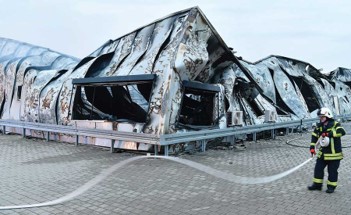
NFPA 855’s requirements fall into several distinct compliance domains. Each must be addressed for a BESS installation to be approved by the AHJ:
1. System Sizing and Capacity Limits
NFPA 855 establishes maximum energy capacity per stationary unit (typically 50 kWh for lithium-ion) and total capacity per protected area, with provisions allowing larger installations when supported by UL 9540A testing demonstrating acceptable failure behavior. Exceeding base capacity limits requires documented justification through testing or HMA.
2. Separation Distances
Minimum separation distances between BESS units, between BESS and exposures (buildings, lot lines, vegetation), and between BESS and ignition sources. Default separations apply unless reduced separation is supported by UL 9540A testing or fire-rated barriers.
3. Ventilation Requirements
Mechanical ventilation systems to prevent accumulation of flammable or explosive off-gas concentrations. Required for indoor and enclosed installations; specific airflow rates are determined by the system size and the gases that the specific battery chemistry can produce during failure.
4. Fire Detection
Continuous fire detection within and around the BESS enclosure — typically combining smoke detection, off-gas detection, and thermal imaging in a layered strategy. Detection must be supervised through a UL 864-listed fire alarm control panel and integrated with the building or site emergency response.
5. Fire Suppression
Automatic suppression appropriate to the installation — water-based systems (sprinklers, water mist), clean agent suppression, or alternative agent systems demonstrated through UL 9540A testing. Suppression design must account for the specific failure behavior of the installed battery technology.
6. Hazard Mitigation Analysis (HMA)
A documented analysis identifying credible failure scenarios for the specific installation and defining the engineering controls, detection, suppression, and emergency response that mitigate each scenario. Required when installation parameters deviate from NFPA 855 prescriptive baselines, and increasingly required by AHJs even when baseline compliance is otherwise met.
7. Emergency Response Plan
Site-specific emergency procedures coordinated with the local fire department, including hazard information, access provisions, isolation procedures, and post-incident management. Responder training and pre-incident planning increasingly required for installations of meaningful capacity.
8. Commissioning and Testing Documentation
Full documentation of system commissioning, acceptance testing of all fire safety subsystems, and ongoing inspection records. Required for AHJ approval and increasingly required for insurance underwriting.
The practical compliance challenge: NFPA 855 is not a single checklist. It is a framework where the specific requirements depend on the battery chemistry, system size, location, building type, and AHJ interpretation. Two BESS installations with the same nameplate capacity in different jurisdictions can have substantially different compliance paths. Engaging fire protection engineering early in the project — before equipment is ordered — prevents expensive redesign during AHJ review.
What Is UL 9540A and Why Does It Matter for NFPA 855?
UL 9540A — Standard for Test Method for Evaluating Thermal Runaway Fire Propagation in Battery Energy Storage Systems — is the laboratory test methodology that establishes how a specific battery system behaves during a thermal runaway event. The test characterizes failure propagation, off-gas composition, fire behavior, and the effectiveness of fire protection responses.
UL 9540A results directly affect NFPA 855 compliance:
- Capacity exceedance justification — UL 9540A testing can support installations exceeding NFPA 855 base capacity limits when test results demonstrate acceptable failure behavior
- Reduced separation distances — UL 9540A testing showing limited fire propagation can support reduced separation between BESS units
- Suppression effectiveness — testing demonstrates which suppression approaches actually work for the specific battery system, informing engineering decisions about agent selection and quantity
- HMA inputs — UL 9540A results provide the foundation data for credible failure scenarios in the Hazard Mitigation Analysis
- Off-gas characterization — identifies the specific gases produced during thermal runaway, informing both detection technology selection and ventilation design
A BESS project without UL 9540A test data for the specific installed system has significantly less flexibility under NFPA 855 — and typically faces tighter prescriptive requirements during AHJ review. Most major battery system manufacturers now provide UL 9540A test reports as standard documentation; SSI works with these reports during the design and HMA process.
Which Detection Technologies Satisfy NFPA 855?
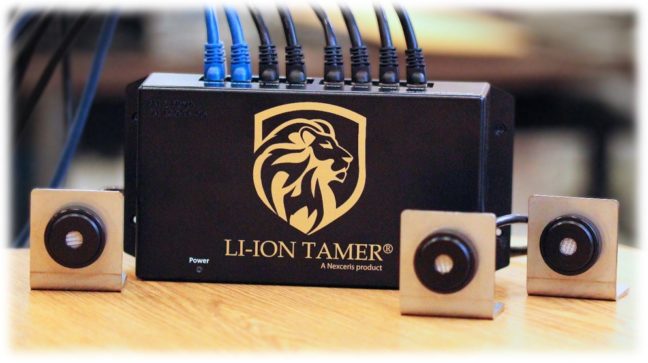
NFPA 855 does not mandate a specific detection technology by name — it requires that detection be capable of identifying fire conditions reliably within the BESS environment. In practice, the technologies that satisfy this requirement for lithium-ion installations are a small set, each addressing a different phase of the thermal runaway progression:
| Detection Technology | Detects | Lead Time |
|---|---|---|
| Thermal imaging | Pre-ignition cell heating | Minutes to hours before off-gas |
| Li-Ion Tamer off-gas detection | Electrolyte vapor and decomposition gases | 2 to 30 minutes before thermal runaway |
| VESDA air sampling | Incipient smoke particles | Before visible smoke |
| Video Fire Detection | Visible smoke and flame | Real-time fire confirmation |
| Conventional smoke detection | Visible smoke at ceiling level | After fire is established |
Most NFPA 855 compliant BESS installations use a layered detection approach — typically combining off-gas detection (Li-Ion Tamer) with thermal imaging and/or VESDA, with conventional smoke detection as a backup layer. The combination provides both the earliest possible warning (thermal imaging during Phase 1 heating) and the most chemistry-specific signal (off-gas detection during Phase 2 venting), ensuring that the failure is identified regardless of which signal develops first.
The choice of which combination to deploy depends on the specific battery chemistry, the installation environment (indoor enclosure vs. outdoor container vs. building-integrated), the UL 9540A test results, and the HMA conclusions. SSI designs the detection strategy as part of the integrated NFPA 855 compliance approach, not as a standalone equipment selection.
What Is a Hazard Mitigation Analysis (HMA)?
The Hazard Mitigation Analysis is the engineering document that NFPA 855 uses to evaluate non-prescriptive installations — and increasingly, AHJs require it even for prescriptive-compliant installations. The HMA identifies the credible failure scenarios for the specific BESS, evaluates the consequences of each, and documents the engineering controls that mitigate them.
A complete HMA typically addresses:
- Single-cell failure — what happens when one cell enters thermal runaway, and how propagation is prevented
- Single-module failure — propagation between cells within a module and prevention of escalation to adjacent modules
- Single-rack failure — module-to-module propagation within a rack and prevention of rack-to-rack escalation
- Multi-rack scenarios — the consequences if propagation is not contained at the rack level
- External fire exposure — what happens if a fire outside the BESS enclosure exposes the batteries
- Off-gas release scenarios — accumulation, ventilation effectiveness, and explosion risk
- Loss of BMS function — failure modes when the battery management system itself is compromised
- Loss of detection or suppression — defense-in-depth analysis when individual fire safety systems are unavailable
- Emergency response constraints — site-specific limitations on responder access, water supply, and isolation capability
For each scenario, the HMA documents the detection technology, suppression response, ventilation, isolation, and emergency response that prevents the scenario from progressing to catastrophic loss. The completed HMA becomes part of the AHJ submittal and the facility’s operating documentation.
SSI participates in HMA development as the fire detection and suppression engineering partner — providing detection technology specifications, suppression system design, response timing analysis, and integration documentation that supports the HMA conclusions.
What Other Codes Apply Alongside NFPA 855?
NFPA 855 is the central standard, but BESS installations operate within a multi-code framework. SSI engineers compliance across the full applicable stack:
| Standard | What It Governs |
|---|---|
| NFPA 855 | Stationary Energy Storage Systems — primary BESS fire safety code |
| UL 9540 | Energy Storage Systems and Equipment — listing standard for the BESS itself |
| UL 9540A | Test Method for Evaluating Thermal Runaway Fire Propagation — failure behavior characterization |
| NFPA 72 | National Fire Alarm and Signaling Code — detection system design, supervision, testing |
| NFPA 13 | Installation of Sprinkler Systems — when sprinklers are the selected suppression approach |
| NFPA 2001 | Clean Agent Fire Extinguishing Systems — when clean agents are part of the suppression strategy |
| NFPA 70 (NEC) | National Electrical Code — electrical installation, disconnects, and protection |
| International Fire Code (IFC) Chapter 12 | Local fire code provisions for ESS that mirror or reference NFPA 855 |
| UL 864 | Fire alarm control unit listing — required for the panel supervising BESS detection |
| Local AHJ amendments | Jurisdiction-specific modifications, additional requirements, and interpretation |
The IFC and local AHJ amendments are particularly important: New York City (FDNY), California, and other jurisdictions have implemented additional requirements that go beyond NFPA 855 baseline — including enhanced detection, expanded HMA scope, and specific responder training requirements. SSI maintains current awareness of AHJ-specific requirements across the regions we serve.
Where SSI Fits in the NFPA 855 Compliance Path
NFPA 855 compliance is a multi-discipline effort. SSI’s role focuses on the fire detection, suppression, and emergency response infrastructure — the technical core of the standard. We work alongside the battery system supplier, EPC contractor, electrical engineer, structural engineer, and fire protection engineer of record to deliver the integrated fire safety system.
1. Design Phase
Detection technology selection based on UL 9540A results and HMA scenarios. Suppression approach engineering. Integration with the building or site fire alarm platform. AHJ submittal package preparation.
2. HMA Support
Detection and suppression engineering documentation supporting the HMA scenarios. Response timing analysis. Defense-in-depth coverage validation. Integration of fire safety systems into the HMA conclusions.
3. Installation and Commissioning
Detection system installation, fire alarm panel integration, suppression system installation, full acceptance testing, and commissioning documentation for the AHJ.
4. Operator Training and Documentation
Facility operator training on detection alarm interpretation, response procedures, system bypass and isolation. Coordination with local fire department for pre-incident planning.
5. Annual Inspection and Service
NFPA 72 annual testing of detection systems, NFPA 2001 inspection if clean agents are installed, sensor recalibration, panel software updates, and ongoing compliance documentation for insurance and regulatory reporting.
Frequently Asked Questions
When did NFPA 855 take effect?
NFPA 855 was first published in 2020 and has been updated in subsequent code cycles. The standard is adopted by reference in many state and local fire codes, including the International Fire Code (IFC) Chapter 12. Specific enforcement dates depend on the local AHJ’s adoption schedule, which varies by jurisdiction.
Does NFPA 855 apply to residential battery storage?
Single-family residential storage is typically governed by separate residential code provisions, not by NFPA 855 in its full form. However, NFPA 855 does apply to multi-unit residential installations, mixed-use buildings, and any installation above the residential capacity thresholds. The dividing line varies by jurisdiction; the local AHJ confirms which code framework applies.
What is the difference between NFPA 855 and UL 9540?
UL 9540 is the listing standard for the energy storage system itself — the equipment must be UL 9540 listed to be installed in most jurisdictions. NFPA 855 governs how a UL 9540 listed BESS is installed, including separation, ventilation, detection, suppression, and emergency response. UL 9540A is a separate test method that characterizes thermal runaway behavior and is referenced by NFPA 855 for justifying installations beyond prescriptive baselines.
Is a Hazard Mitigation Analysis always required?
Under the strict language of NFPA 855, the HMA is required when installation parameters deviate from prescriptive baselines. In practice, an increasing number of AHJs require the HMA for any BESS installation of meaningful capacity, regardless of whether prescriptive compliance is otherwise met. We recommend treating the HMA as standard for any non-residential BESS project.
Does NFPA 855 require both smoke and off-gas detection?
NFPA 855 does not prescribe a specific combination of detection technologies by name — it requires reliable fire detection within the BESS environment. In practice, lithium-ion installations of meaningful capacity typically combine off-gas detection with smoke detection and/or thermal imaging in a layered strategy. The specific combination is determined during the HMA based on the battery chemistry, installation environment, and UL 9540A results.
Can existing BESS installations be retrofitted to meet current NFPA 855?
Yes, and many existing installations face retrofit pressure as insurers, AHJs, and project owners apply current standards retroactively after high-profile incidents. Retrofit projects typically focus on detection upgrades (adding off-gas detection or thermal imaging), suppression enhancement, ventilation improvements, and HMA development. SSI evaluates existing installations and recommends retrofit approaches scaled to the risk profile and budget.
What is the cost of NFPA 855 compliance?
Cost varies based on system size, location, battery chemistry, and the specific compliance path. Detection and suppression infrastructure for a containerized utility-scale BESS represents a different cost profile than a building-integrated commercial installation. Engaging fire protection engineering early in the project — during conceptual design — typically reduces total compliance cost by 20% to 40% compared to retrofitting compliance into a completed design. SSI provides project-specific budgeting after a site evaluation.
How often does NFPA 855 update?
NFPA 855 follows the standard NFPA revision cycle — typically every three to five years. Each cycle incorporates lessons from real-world incidents, advances in detection and suppression technology, and clarifications driven by AHJ enforcement experience. Local jurisdictions adopt new editions at different rates; the version enforced at your specific project location depends on the local code adoption schedule.
What happens if a BESS installation fails NFPA 855 review?
AHJ review typically identifies specific deficiencies that must be corrected before installation approval — separation distance issues, detection coverage gaps, HMA inadequacies, or documentation shortfalls. The corrective path depends on the finding; some are resolved through additional engineering documentation, others require physical changes to the installation. Engaging an experienced fire protection partner during early design substantially reduces the risk of substantive findings during AHJ review.
Bringing NFPA 855 Compliance Into Your BESS Project
Whether you’re planning a utility-scale BESS installation, a behind-the-meter commercial project, a microgrid, or a retrofit of an existing system, fire safety engineering belongs in the project early — not at AHJ review.
Suppression Systems, Inc. engineers, installs, and maintains NFPA 855 compliant fire detection and suppression infrastructure for battery energy storage installations across the East Coast. Our NICET-certified team participates in HMA development, AHJ coordination, detection technology selection, suppression engineering, and ongoing service through the system’s full operational life.
Contact SSI today to schedule a BESS fire safety consultation or discuss NFPA 855 compliance for your project. We serve Pennsylvania, New Jersey, Maryland, Virginia, and Delaware.